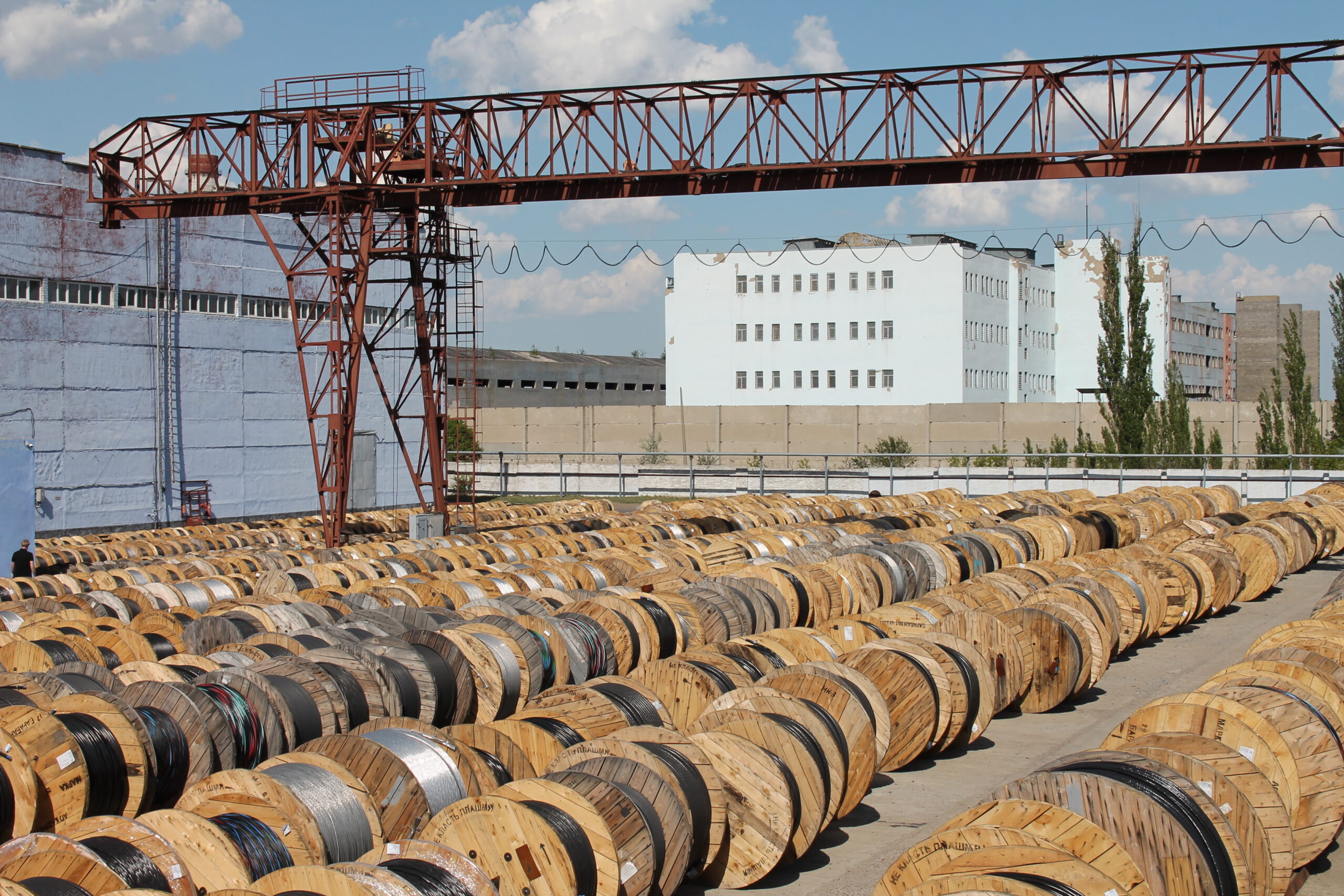
Introduction: two categories of UTP twisted pair
UTP twisted pair is the standard for building local area networks. When buying a reel for a home or office, the main choice is between categories 5e and 6. Both are produced as unshielded cables with four pairs of copper conductors, both are designed for data transmission up to 100 metres. The difference lies in the frequency potential and internal geometry.
Cat5e UTP cable is certified for frequencies up to 100 MHz and guarantees gigabit speed over the full line length. UTP Cat6 raises the bar to 250 MHz and can transmit 10 Gbit/s over distances up to 55 metres. This basic difference determines the application scenarios: apartment, office, data centre or multi‑gigabit backbone. A complete guide to UTP construction and twisted pair types is given in the article about UTP cable, and installation rules and standards are covered in UTP cable laying.
Comparative table of Cat5e and Cat6
| Parameter | UTP Cat5e | UTP Cat6 |
| Frequency range | 100 MHz | 250 MHz |
| Speed over 100 m | up to 1 Gbit/s (1000BASE‑T) | up to 1 Gbit/s (1000BASE‑T); up to 10 Gbit/s over 55 m (10GBASE‑T) |
| Maximum speed over short distances | 1 Gbit/s | 10 Gbit/s |
| Standard | TIA/EIA‑568‑C.2, ISO/IEC 11801 Class D | TIA/EIA‑568‑C.2, ISO/IEC 11801 Class E |
| Conductor diameter | 24 AWG | 24 AWG (sometimes 23 AWG for lower attenuation) |
| Number of pairs | 4 pairs (4pr) | 4 pairs (4pr) |
| Separator element | None | Often a cross‑shaped plastic filler separating the pairs |
| Attenuation at 100 MHz | 22 dB/100 m | 19.8 dB/100 m |
| NEXT at 100 MHz | 35.3 dB | 44.3 dB |
| Cable thickness | Thinner, typically 0.5 cm | Thicker, up to 0.6 cm |
| Minimum bending radius | 4 cable diameters | 4 cable diameters |
| Backward compatibility | Compatible with Cat5, Cat3 (with limitations) | Fully compatible with Cat5e and Cat5 |
| Sheath material | PVC or LSZH | PVC or LSZH |
| Cable cost (305 m reel) | Lower | 30‑50% higher |
| Installation cost | Lower, easier termination | Slightly higher due to stiffer construction |
| Main application | Gigabit networks at home and office, IP cameras, VoIP | Networks with headroom for 10 Gbit/s, data centres, backbone segments |
Key differences: frequency, speed and construction
The difference between Cat5e and Cat6 twisted pair starts with physics: the higher 250 MHz frequency of Cat6 requires better suppression of crosstalk. Manufacturers achieve this through tighter pair twisting, an increased lay length, and almost always a plastic cross‑shaped separator that physically spaces the pairs apart. This element makes Cat6 noticeably stiffer and thicker.
Cat5e suppresses crosstalk solely through the balanced scheme and twisting, without an additional filler. Therefore, the cable remains flexible, which simplifies laying in confined spaces — chases, cable ducts, corrugated tubes. At the same time, it fully satisfies the gigabit standard 1000BASE‑T, and for the vast majority of home and office tasks this is sufficient. For a comparison of shielded and unshielded versions, read the article UTP or FTP.
Both types use copper conductors of 24 AWG gauge. Some Cat6 cables use 23 AWG to reduce insertion loss. The conductor material is solid copper, not copper‑clad aluminium. On 305‑metre reels you may see the marking 4pr, meaning four pairs. The designation U/UTP indicates the complete absence of shields: neither overall nor individual. F/UTP has a common foil shield, but that is a different type, beyond the scope of comparing pure UTP.
Throughput and real‑world load
In practice, a gigabit network with switches and Wi‑Fi 6 access points has enough bandwidth of 1 Gbit/s per subscriber line. UTP Cat5e handles this task at the maximum distance of 100 metres. Cat6 delivers the same gigabit, but with a frequency margin. This means fewer errors on long routes and stability with partial damage or poor termination.
Where Cat6 pulls ahead is 10‑gigabit networks. The 10GBASE‑T standard works over Cat6 up to 55 metres, and over Cat6a up to 100 metres. Cat5e is not designed for 10G: at frequencies above 100 MHz, crosstalk levels become critical, and the link either fails to come up or runs with packet loss. Therefore, if migration to 10G is planned, it makes sense to install Cat6, especially on backbone segments between floors.
Installation features and compatibility
Both categories use RJ‑45 connectors and are terminated with the same tool. Cat6 is backward compatible with Cat5e: you can connect a Cat6 cable to a Cat5e socket or patch panel, and the link will run at the lower of the two categories. This is convenient for phased network upgrades.
However, Cat6 is more sensitive to geometry disturbances. The bending radius is formally the same — 4 diameters — but due to greater stiffness and the presence of a separator, the cable is harder to fit into tight corrugated tubes or behind baseboards. Careless installation can easily damage the pairs or disturb the twist pitch, nullifying the category advantages. The plastic filler must be cut flush with the sheath before termination; otherwise, the cable will not fit into the connector.
The sheath comes in two types: PVC and LSZH. PVC is standard polyvinyl chloride – inexpensive and durable. LSZH is a halogen‑free compound with low smoke emission, mandatory for installation in public buildings and on escape routes. The cable marking includes the corresponding index. Laying standards, including separation from power lines and protection against interference, are covered in the guide UTP cable laying.
When UTP Cat5e is sufficient
- Home networks for internet, streaming, IPTV. A gigabit channel is more than enough for years to come.
- Office workstation cabling, if migration to 10‑gigabit speeds is not planned.
- IP video surveillance systems — cameras rarely require more than 100 Mbit/s.
- Temporary networks and budget projects where cost savings are important while maintaining reliability.
- Facilities with complex routes where cable flexibility is more important than frequency headroom.
When it is worth upgrading to UTP Cat6
- Building a new office network with an eye on 10‑gigabit backbones. Cat6 allows deploying 10G without replacing the cable on short spans.
- Data centres and server rooms with high traffic density and multi‑gigabit connections.
- Routes longer than 50‑60 metres where stable gigabit with low BER is required.
- Spaces with high electromagnetic interference — Cat6’s improved noise immunity gives fewer errors.
- Facilities where certification of the SCS to Category 6 according to ISO/IEC 11801 is important for future leasing or sale.
Recommendations by use case
| Scenario | UTP category | Justification |
| Apartment, internet + IPTV | Cat5e | Gigabit is sufficient, routes are short |
| Private house with several Wi‑Fi access points | Cat5e | Frequency headroom is not needed, material savings |
| Office for 20‑50 workstations | Cat5e | Office applications do not exceed 1 Gbit/s per port |
| Data centre server room, rack connections | Cat6 | 10G capability up to 55 m, lower attenuation |
| Educational institution, administrative building | Cat6 LSZH | Fire safety, headroom for future speeds |
| Production workshop with CNC machines | Cat6 or FTP | Immunity to interference, robust construction |
Typical mistakes when choosing a category
- Buying Cat6 for “higher speed” in an apartment. The provider’s gigabit tariff will not become faster from changing the cable — Cat5e fully delivers 1 Gbit/s.
- Using Cat5e on a long inter‑building backbone expecting 10G. The link will not reach the target speed, requiring cable replacement.
- Buying cheap cable with copper‑clad aluminium (CCA) instead of solid copper. Such wire is brittle, has higher resistance and is not TIA/EIA‑certified. Neither Cat5e nor Cat6 should be CCA.
- Installing Cat6 with sharp bends and violating the bending radius. The separator breaks, pairs shift, and performance drops to Cat5e level.
- Ignoring sheath type: using PVC where fire safety regulations require LSZH will lead to compliance issues. Public buildings require LSZH.
- Skimping on patch cords and outlets: installing Cat5e components on a Cat6 line will downgrade it to Cat5e. All elements of the link must be of the same category.
Frequently asked questions
What is the difference between Cat5e and Cat6?
Frequency: 100 MHz for Cat5e, 250 MHz for Cat6. Cat6 supports 10 Gbit/s up to 55 m and has better noise immunity. Cat5e delivers gigabit up to 100 m.
Which is better for an apartment: UTP Cat5e or Cat6?
For a typical apartment with internet up to 1 Gbit/s, Cat5e is perfectly adequate. Cat6 does not increase speed but costs more and is stiffer to install.
Can Cat5e and Cat6 be mixed in the same network?
Yes, they are fully compatible. The link will run at the speed of the lowest category in the chain. A Cat5e outlet with Cat6 cable will give gigabit, but not 10G.
What does the marking 4pr 24AWG on a reel mean?
4pr means 4 pairs of conductors, 24AWG is the conductor gauge (0.51 mm). This is the standard designation for UTP Cat5e and Cat6 cables. A reel typically contains 305 m.
What is the difference between U/UTP and F/UTP?
U/UTP is completely unshielded twisted pair. F/UTP has a common foil shield. In the context of Cat5e and Cat6, UTP means U/UTP.
What is the service life of UTP Cat5e and Cat6 cables?
With indoor fixed installation, both types last at least 25 years. The main enemies are ultraviolet light and moisture, so special outdoor versions are needed for exterior use.
Is it mandatory to use a Cat6 patch panel for Cat6 cable?
Yes, to maintain the category, all components — cable, outlets, patch cords, patch panels — must be certified for Category 6 or higher.
Conclusion
The choice between UTP Cat5e and Cat6 comes down to two questions: is 10 Gbit/s needed today or within the next 5‑7 years, and what distances must be covered. For gigabit internet, office telephony and IP cameras, Cat5e remains a reasonable and budget‑friendly solution. If the network is built with a reserve for multi‑gigabit applications, and routes run across floors and server rooms, Cat6 becomes a worthwhile investment.
Both categories are available in the catalogue UTP Cat5e. Also available are patch cords, outlets and 305‑metre reels with solid copper 24AWG conductors in PVC or LSZH sheath. Compliance with TIA/EIA‑568 standards and careful installation guarantee a stable network link throughout the entire service life.