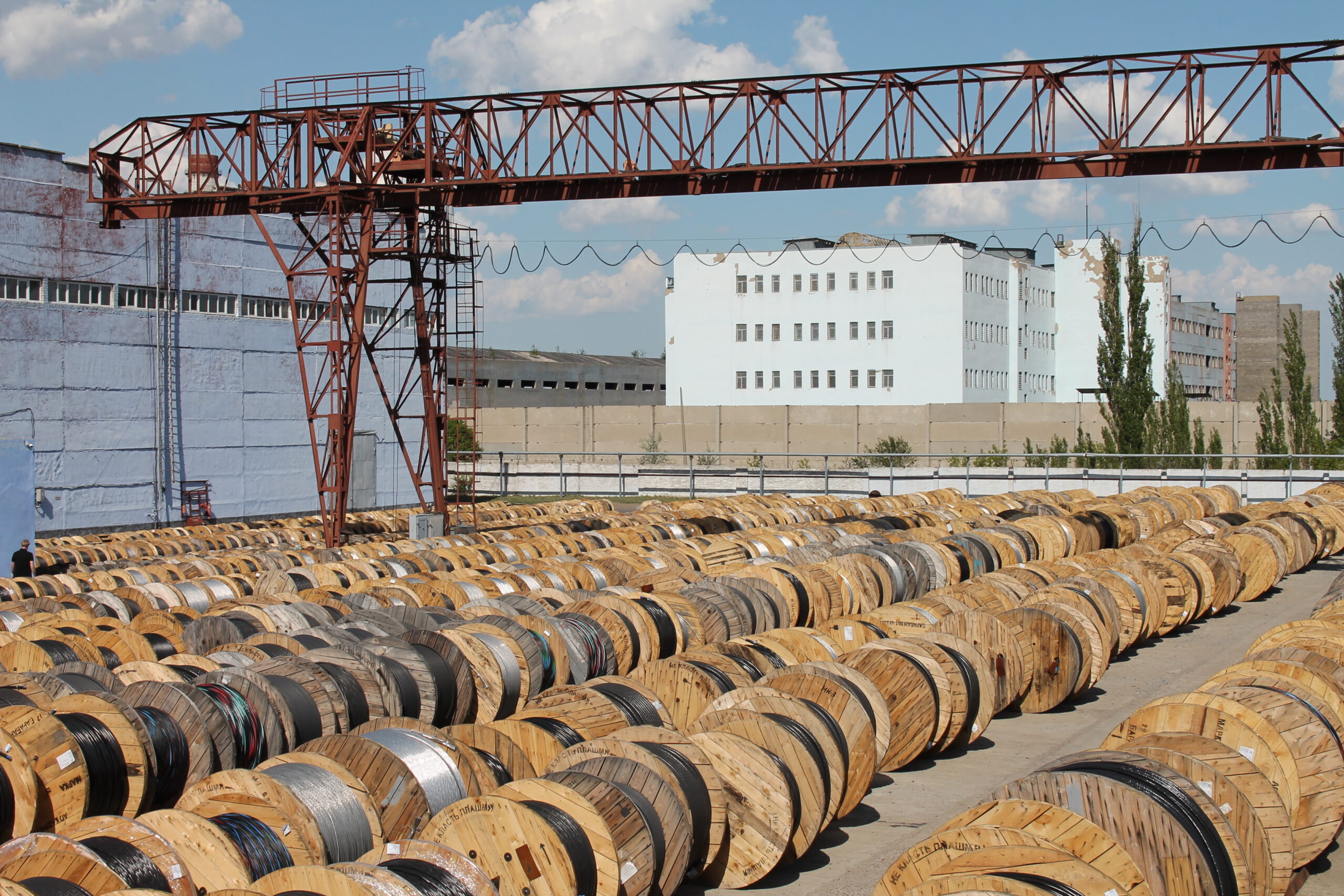
Copper core power cable or aluminum core power cable: which is better to choose
The choice of conductor material for a cable is one of the first questions when designing a power supply system. This article provides a detailed comparison of products with copper and aluminum conductors in terms of key technical, installation and economic parameters. The material is prepared taking into account the requirements of the PUE (Electrical Installation Rules), GOST 22483, GOST 31996, as well as typical solutions for laying lines inside buildings and on outdoor routes.
Both groups of conductors perform the same function — the transmission of electrical energy at voltages up to 1 kV and above. The difference in the physical properties of copper and aluminum determines the permissible current loads, weight, reliability of contact connections and the final cost of the line. Comparative tables by parameter groups are placed in the relevant sections.
1. Throughput capacity and cable cross‑section
Electrical and thermal parameters
| Parameter | Copper cable | Aluminum cable |
| Electrical conductivity | 58.5 MS/m | 34.5 MS/m |
| Resistivity | 0.01724 Ohm·mm²/m | 0.02826 Ohm·mm²/m |
| Permissible current load | Higher for the same cross‑section | Lower — requires increasing the cross‑section by about 60 % for equal current |
| Required cross‑section for the same load | Base (e.g., 10 mm²) | Increased (16 mm² for equivalent conductivity) |
| Voltage drop | Less per unit length | Higher for the same cross‑section; equalised when selecting by conductivity |
| Power losses | Lower | Higher if not compensated by cross‑section |
| Thermal conductivity | 401 W/(m·K) | 237 W/(m·K) |
A copper conductor provides lower resistivity and, consequently, higher throughput. This allows selecting a smaller cross‑section for the same load or obtaining lower voltage drop.
The electrical conductivity of copper is almost twice that of aluminum. According to GOST 22483, the resistivity of a copper conductor is 0.01724 Ohm·mm²/m, while that of aluminum is 0.02826 Ohm·mm²/m. This means that a copper cable carries a higher current for the same cross‑section, or requires a smaller cross‑section for the same load. For example, to transmit 100 A over a distance of 50 m, a copper conductor will require a cross‑section of about 25 mm², whereas an aluminum conductor will need at least 35 mm². More detailed information on cross‑section selection is covered in the article about power cables.
The difference in conductivity directly affects voltage drop. With the same cross‑section, the voltage drop in an aluminum line is about 60 % higher. Designers compensate for this by increasing the cross‑section, which partially offsets the weight advantage. In backbone networks, the choice is often determined by the economic current density according to the PUE, and here copper conductors win in minimising losses, while aluminum wins in capital costs.
2. Cable weight and ease of installation
Mechanical properties and installation convenience
| Parameter | Copper cable | Aluminum cable |
| Cable weight | 2.5–3 times heavier than aluminum | Significantly lighter |
| Flexibility | High, especially for conductors of classes 4 and 5 | Lower; stranded conductors are limited to classes 3–4 |
| Conductor strength | High mechanical resistance to breakage | More brittle, prone to fracture under repeated bending |
| Vibration resistance | Excellent | Satisfactory; requires tightening control of contacts |
| Ease of installation | Easy stripping, flexibility simplifies laying in cabinets | Requires care during connection; bending restrictions |
| Connection reliability | High, low susceptibility to loosening over time | Periodic tightening control required, especially under thermal cycles |
| Heating of connections | Lower with good contact | Higher upon oxidation; critical without bimetallic lugs |
| Contact oxidation | Oxide film is easily broken; contact stable | Oxide film is refractory, requires special treatment and pastes |
Aluminum is much lighter, reducing the load on structures and simplifying transportation. However, copper wins in flexibility, strength and contact stability, which is especially important when installing in confined spaces.
The density of aluminum is 2.7 g/cm³, copper — 8.9 g/cm³. An aluminum conductor is three times lighter than a copper one at equal cross‑sections. This is critical for long routes, where the load on cable structures and ease of unwinding become determining factors. Not surprisingly, aluminum cable AVBbShv (АВБбШв) is widely used in 6–10 kV distribution networks and building entrances.
Overhead lines also favour aluminum: lower weight reduces demands on supports. Inside workshops and in trays, a light cable is easier to secure. However, for internal wiring in residential and office premises, weight is not a decisive argument, and flexibility and ease of connection are on the side of copper. More about installation and route features — in the article cable laying.
3. Cost of copper and aluminum cables
Economic indicators and fire safety
| Parameter | Copper cable | Aluminum cable |
| Service life | 30 years or more when complying with PUE | 25–30 years with proper installation |
| Cable cost | Higher | 2–3 times lower per unit length |
| Installation cost | Lower due to ease of connections | Higher due to mandatory use of bimetallic lugs and additional treatment |
| Operation cost | Lower energy losses, less frequent maintenance | Higher losses, need for contact inspections |
| Fire safety | Melting point 1083 °C; high resistance | Melting point 658 °C; loses mechanical strength faster in fire |
Aluminum cable is significantly cheaper at the procurement stage, but requires additional expenses for fittings and maintenance. The copper option is more economical in the long term due to lower energy losses and infrequent maintenance.
The price per meter of aluminum cable is much lower: the difference can reach two to three times. For objects with long lines, this gives a noticeable budget saving. But analysing only the purchase price does not show the full picture. It is necessary to consider the cost of connecting fittings: for aluminum, bimetallic lugs and lubricants are mandatory, which increases the installation estimate. Copper cables are more expensive, but installation and maintenance costs are lower.
Long‑term operating costs also differ. Energy losses over a 30‑year service life are greater in an aluminum line, and at high tariffs this difference can exceed the initial savings. Therefore, the question of which cable to choose is often resolved by a technical and economic calculation.
4. Installation and connection
Flexible copper cable — for example, grade KG — is easy to strip and bends with small radii. Installation in the confined space of distribution boards, connection to circuit breakers and terminals do not cause difficulties. Copper does not require special contact preparation: the oxide film is easily broken during tightening.
Aluminum conductors, even stranded ones, exhibit creep under pressure. After several heating‑cooling cycles, the contact can loosen, requiring periodic re‑tightening. According to GOST 10434‑82, connections of aluminum conductors must be made only with bimetallic lugs or paste that prevents oxidation. Without this, the contact resistance increases, heating the joint. An aluminum conductor imposes higher requirements on the qualifications of electricians.
For mobile connection of equipment, flexible cable KG with copper conductors is the unambiguous choice — it is designed for repeated bends and vibration. Aluminum analogues with such a flexibility class are practically not produced.
5. Reliability, service life and safety
The mechanical strength of a copper conductor is higher: it withstands more bends and does not break under vibration. This makes the copper conductor more reliable on moving sections and under dynamic loads. In addition, the melting point of copper reaches 1083 °C, providing better resistance to short circuits and overloads.
Aluminum oxidises more intensively when heated, and the oxide film Al₂O₃ has high electrical resistance. Without proper protection, the contact unit overheats, increasing the risk of fire. That is why inside buildings, regulations SP 256.1325800.2016 recommend copper cable VVGng or VVGng LS, especially in fire protection systems. For fire‑resistant lines, there are designs described in the guide fire‑resistant cable.
The service life of a copper cable, provided that current modes and laying conditions are observed, exceeds 30 years. Aluminum, with high‑quality installation, serves at least 25 years, but requires more careful control of connections.
6. Popular grades of copper and aluminum cables
Copper cables
- VVG — cable with copper conductors in PVC insulation and sheath, without armour. The main solution for stationary laying inside buildings and outdoors. Complies with GOST 31996. Available with 1 to 5 cores.
- VVGng — a variant of VVG that does not propagate flame in group laying. Used in residential, administrative and industrial buildings where increased fire safety requirements are imposed.
- VVGng‑LS — additionally features low smoke and gas emission. Recommended for facilities with large numbers of people. Often found in schools, hospitals, shopping centres.
- KG — flexible cable with copper conductors of class 5 according to GOST 22483. Designed for connecting mobile equipment and mechanisms.
- VBbShv — copper armoured cable with protection of galvanised steel tapes. Used for laying in the ground and in conditions of risk of mechanical damage.
The range of copper conductor cables is presented in the catalogue.
Aluminum cables
- AVVG — analogue of VVG with aluminum conductors. Designed for stationary laying outdoors and in industrial premises where high flexibility is not required.
- AVVGng — non‑flammable version of AVVG for group laying. Popular in distribution networks of industrial facilities.
- AVBbShv — armoured cable with aluminum conductors. Optimised for laying in trenches and on overpasses. Withstands high mechanical loads.
The full list of aluminum conductor cables is available on the website.
7. Where it is better to use copper cable
- Apartments and private houses. For internal wiring of socket and lighting networks, copper conductors are used without alternative. The PUE and SP standards prescribe copper conductors with a cross‑section from 1.5 mm² for lighting and from 2.5 mm² for sockets.
- Offices and commercial premises. Compact laying in cable ducts, trays and behind suspended ceilings is required. Copper cable provides minimal dimensions for a given load.
- Equipment connection. Machines, compressors, welding stations are connected with flexible copper cable KG. It is resistant to bends and vibrations.
- Backup power systems. Circuits of diesel generator sets, UPS require high reliability. Voltage losses in copper lines are minimal, and contacts are stable.
- Fire‑resistant lines. For smoke exhaust and fire alarm systems, a fire‑resistant cable with copper conductors is chosen, which maintains operation for at least 180 minutes during a fire.
8. Where it is better to use aluminum cable
- Building entrances. From the overhead line support to the input switchboard, an aluminum conductor with a cross‑section of 16–25 mm² is laid, which is permitted by regulations and economically advantageous.
- Outdoor networks. Cable lines between transformer substations and distribution points, as well as overhead trunk lines, are predominantly made of aluminum.
- Long routes. At distances of hundreds of meters, reducing capital costs for material is significant. Armoured aluminum cable AVBbShv is laid in the ground and on overpasses.
- Industrial facilities. In workshops, warehouses and open areas, where the construction budget is limited, aluminum cables win in initial price.
- Distribution networks. Racks, mains in cable basements and risers of multi‑storey buildings are often made of four‑core or five‑core aluminum.
9. What to choose in different situations
| Situation | Recommended option | Reason |
| Apartment | Copper cable VVGng‑LS | Fire safety requirements, compactness, easy installation in socket boxes and panels |
| Private house | Copper VVGng for internal wiring; aluminum AVVG 16 mm² for entry | Balanced solution in cost and reliability |
| Summer cottage | Aluminum AVVG for lighting and sockets | Minimal costs for seasonal operation |
| Industrial facility | Copper armoured for critical circuits; aluminum armoured for trunk lines | Budget optimisation without compromising key nodes |
| Warehouse | Aluminum AVVGng | Large distances, open laying on trays, less stringent flexibility requirements |
| Production workshop | Copper VVGng for machine tools; aluminum for lighting | Vibrations and bends require copper; for lighting, savings are important |
| Long cable line | Aluminum AVBbShv | Low route cost, light weight reduces load on structures, losses compensated by cross‑section |
| Limited budget | Aluminum cable | Two‑fold cost difference allows meeting the estimate |
| Maximum reliability | Copper VVGng LS or armoured copper | Contact stability, lower losses, high thermal resistance |
| Flexible equipment connection | Copper KG | Only copper provides flexibility class 5 and withstands frequent moves |
10. Which is better: copper or aluminum cable
There is no single answer. Copper conductor leads in conductivity, contact reliability and ease of installation. It is indispensable inside buildings, for flexible connections and in safety systems. Aluminum gives an advantage in weight and initial cost, making it profitable for long trunk lines, overhead lines and with a limited budget.
When choosing, take into account: the PUE standards for residential premises, requirements for voltage losses, permissible current load according to GOST 31996, installation and maintenance costs. Inside apartments and offices, preference is given to copper. On inputs and distribution networks, aluminum remains economically justified. The final decision is always made on the basis of the project, and the presented information helps to make this choice an informed one.