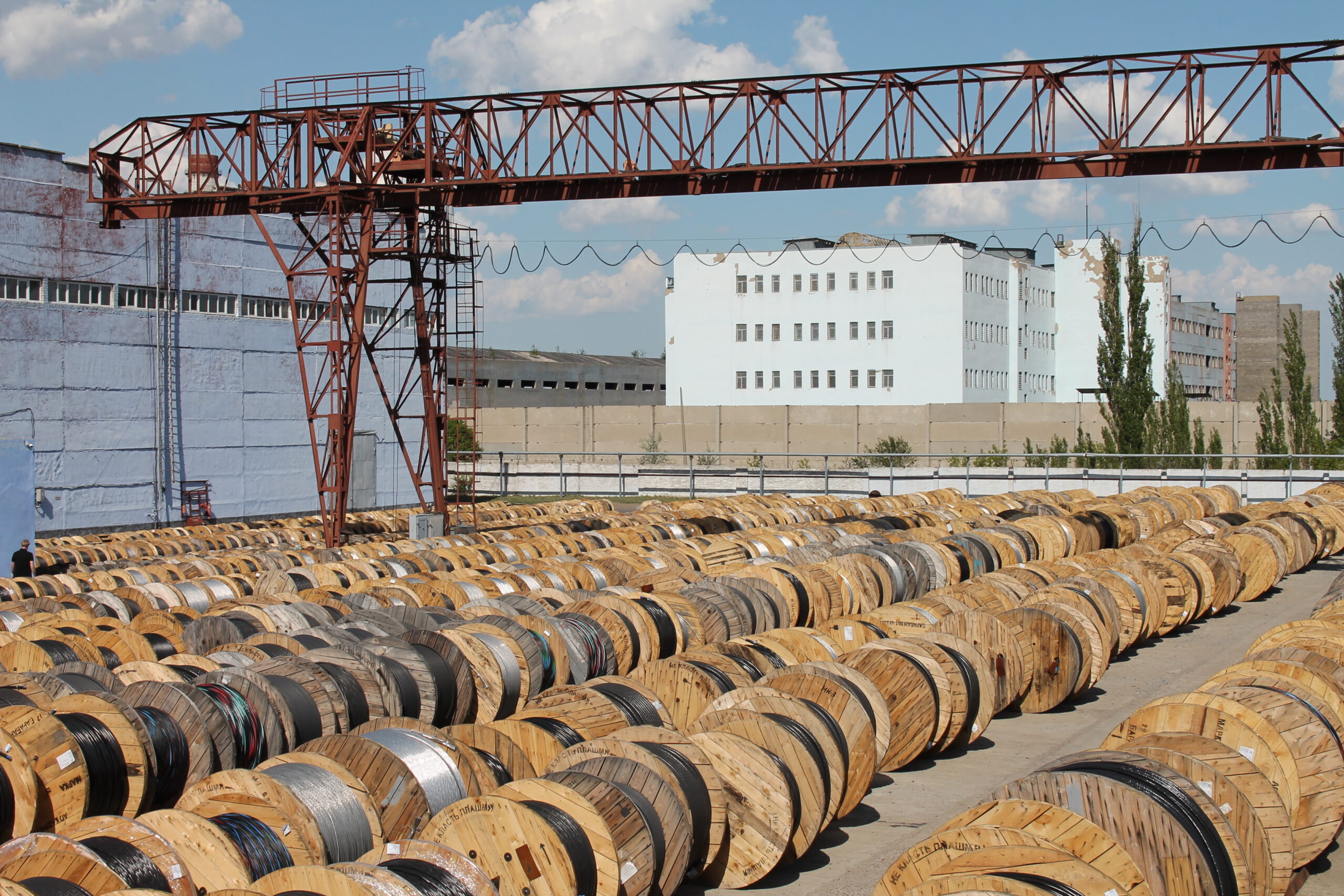
Introduction: Rubber and PVC Insulation in Power Cables
Power cables with rubber insulation and cables with PVC insulation cover two different classes of tasks. The former are flexible, resistant to frost and vibrations, the latter are rigid, cheap and mass-produced. The choice between them is dictated by the installation conditions and the type of connected equipment. Rubber cable of the KG or KGN type is indispensable on construction sites and mobile mechanisms. PVC cables VVG, VVGng, AVVG form the basis of fixed wiring in homes and offices. How power lines are constructed and what other insulation materials exist is described in the material all about power cable.
Comparative Table of Rubber and PVC Insulation
| Parameter | Rubber insulation (KG, KGN) | PVC insulation (VVG, AVVG) |
| Insulation material | Natural or butadiene rubber; sheath — rubber hose | Polyvinyl chloride compound; sheath — PVC |
| Flexibility | Very high (flexibility class 5 according to GOST 22483) | Medium; for flexible modifications achieved by stranded conductor |
| Operating temperature | From –40 to +50 °C (for frost-resistant grades down to –60 °C) | From –50 to +50 °C, but installation at –15 °C and below requires pre-heating |
| Short-circuit temperature (up to 5 s) | Up to 200 °C | Up to 160 °C |
| Resistance to ultraviolet | Moderate; rubber stiffens over time in the sun | Low; PVC degrades under UV, protection is required |
| Resistance to oils and fuel | High in oil- and petrol-resistant grades (KGN) | Low; oils cause swelling and loss of strength |
| Fire-safe versions | Not typical; rubber is combustible, emits smoke | ng, ng-LS, ng-HF — a wide choice of fire-safe sheaths |
| Service life in fixed wiring | 15–20 years; outdoors rubber ages faster | 25–30 years provided temperature regimes are observed |
| Cost (per metre, copper 4×6) | 1.5–2 times higher | Lower, an economical mass product |
| Main application | Mobile mechanisms, construction sites, temporary networks, vibrating equipment | Fixed wiring inside buildings, in cable ducts, in the ground under protection |
Flexibility and Mechanical Properties
Rubber insulation combined with a class 5 stranded conductor gives exceptional flexibility. KG and KGN cables are capable of operating with a bending radius of up to 5 outer diameters and withstanding multiple bends without destruction. This is fundamentally important for connecting welding machines, perforators, compressors, as well as on gantries where the cable is in motion. PVC insulation in VVG cables, even with a stranded conductor, remains quite rigid: the bending radius is not less than 7.5 diameters, and with frequent rewinding the sheath may crack.
In terms of wear resistance, rubber is inferior to PVC under stationary conditions. The rubber jacket wears down over time against concrete walls, metal trays, while PVC is more resistant to friction. Therefore, in permanent wiring, preference is given to a PVC sheath, and rubber is justified only where flexibility is the primary requirement. More about the choice between copper and aluminium conductors inside these types can be found in the comparison copper or aluminium.
Temperature Range and Weather Resistance
Rubber insulation remains flexible at –40 °C and even lower for frost-resistant formulations. KG cables do not need pre-heating before winter installation. PVC compound hardens at sub-zero temperatures, and bending without preliminary warming leads to cracks. Therefore, for outdoor work in cold climates, rubber cables are preferable. However, when heated, rubber ages faster than PVC: prolonged operation at the limit of 50–60 °C accelerates oxidation and loss of elasticity.
Ultraviolet radiation destroys both materials, but for rubber this process is slower. Nevertheless, open outdoor installation in the sun shortens the life of both rubber and PVC cable. For fixed outdoor lines, polyethylene or special UV-stabilised sheaths are optimal. And for temporary outdoor connections, rubber cable is a proven solution. The installation requirements and bending radii for both types are disclosed in the guide cable laying.
Resistance to Oils, Fuel and Chemicals
Rubber is by default sensitive to petroleum products: ordinary KG is destroyed by contact with oil, petrol, diesel. However, the KGN grade has an oil- and petrol-resistant sheath and insulation, which makes it indispensable at oil and gas facilities, in car repair shops, and on railways. PVC compound is also destroyed by contact with hydrocarbons, swells and cracks. In chemically active environments, neither rubber nor PVC provides complete protection — special insulation materials, for example, fluoroplastic, are used. But in standard workshop conditions with machine oil, the advantage belongs to rubber cables KGN.
Fire Safety and Smoke Emission
Rubber is a combustible material with dense black smoke and high toxicity of combustion products. KG cables are not produced in ng-LS versions. They are not laid permanently in residential and public buildings. PVC cables, on the contrary, have a wide range of fire-safe versions: ng — non-propagation of combustion, LS — low smoke formation, HF — halogen-free. The compound of reduced flammability ng-LS complies with the strict standards of SP 256.1325800.2016 and is used in schools, hospitals, offices. Fire-resistant modifications of PVC cables are described in detail in the article about armoured, where safety requirements are also considered.
Cost and Service Life
A rubber cable KG 4×6 copper costs almost twice as much as a PVC analogue VVG 4×6. The reason is a more expensive insulation material and a complex technology for applying the rubber sheath. Temporary networks and connection of mobile equipment justify this price. Fixed wiring with a rubber cable is economically inexpedient: PVC is cheaper, more durable in statics and better meets fire standards.
The service life of rubber insulation under favourable conditions reaches 20 years, but in the sun, frost or an oily environment it is reduced to 7–10 years. A PVC cable serves 25–30 years provided it is not subjected to multiple bends and is not operated at the temperature limit. With mobile installation, PVC wears out quickly: already after a hundred bending cycles, cracks appear on the sheath. Rubber is specially created for such regimes. The range of PVC cables with various cross-sections is presented in the section with PVC insulation.
When to Choose a Cable with Rubber Insulation
- Mobile and portable current collectors: welding machines, compressors, cranes, overhead travelling cranes. KG is indispensable for powering moving mechanisms.
- Construction sites and temporary networks: the cable is unwound, loaded, coiled, works in dirt and rain.
- Operation in the cold: installation at –30 °C without cracks, elasticity in frost.
- Vibrating equipment: shot blasters, vibrating tables, machine tools — a rigid PVC cable breaks under the influence of vibration.
- Oil- and petrol-resistant conditions: KGN with a rubber sheath withstands contact with petroleum products.
When to Choose a Cable with PVC Insulation
- Fixed wiring in buildings: VVG, VVGng, VVGng-LS — the basis of apartment, office and industrial switchboards.
- Any facilities with fire safety requirements: PVC compound of reduced flammability LS gives the required index.
- Laying in the ground, ducts, trays without movement. Rigidity is not a hindrance here, but price and durability in statics are at their best.
- Budget projects with a large length: PVC cable is noticeably cheaper than rubber, which is critical for kilometre-long routes.
- Backbone networks inside workshops where flexibility is not required, but stability of parameters and a service life of 30 years are important.
Typical Mistakes in Selection and Installation
- Using rubber KG for concealed wiring in walls. Fire standards do not allow rubber cables in fixed wiring of residential premises without special protection.
- Laying VVG to a mobile compressor instead of KG. After a month, cracks will appear on the PVC, and the insulation will tear at the entry to the plug.
- Installing PVC cable at –10 °C without pre-heating. The compound becomes brittle, and when bent, the sheath and conductor insulation crack.
- Terminating a rubber cable without sealing the ends. Moisture penetrates under the sheath, and the rubber loses its dielectric properties.
- Replacing KG with VVG in a network with vibration. Rigid PVC insulation transmits vibration to the contact terminals, they loosen and heat up.
- Buying a rubber cable for long-term outdoor installation in the sun. UV radiation destroys the rubber, and the service life is halved.
Frequently Asked Questions
What is the difference between KG and VVG cable?
KG is a flexible cable with rubber insulation and a rubber sheath, intended for mobile connection. VVG — with PVC insulation and a PVC sheath, for fixed installation. The first is flexible and frost-resistant, the second is rigid and fire-safe.
Which cable is better for outdoors: rubber or PVC?
For temporary outdoor connections, rubber KG is suitable — it is not afraid of the cold. For a fixed outdoor route, an armoured cable with a PVC or polyethylene sheath is better; PVC without UV protection degrades quickly. Rubber also ages in the sun, but more slowly.
Can a rubber cable be used in the ground?
Ordinary KG is not intended for underground installation: it has no armour and no resistance to soil pressure. There are special flexible armoured cables, but this is a rarity. For the ground, PVC cables in armour are standard — VBbShv, AVBbShv.
Does rubber insulation hold current better than PVC?
The permissible current depends on the conductor cross-section and the insulation temperature. Rubber allows slightly higher heating during a short circuit, but its continuous operating temperature is lower — 65 °C, while for PVC it is 70 °C. In practice, the current loads are close and are determined by the PUE.
What is the compound of reduced flammability in PVC cables?
It is a PVC composition with fire retardants that does not propagate combustion in bundled laying and emits less smoke. It is marked as ng-LS. It is used in public buildings for escape routes.
Which cable lasts longer: rubber or PVC?
In fixed wiring — PVC, 25–30 years. In mobile — rubber, because PVC cracks quickly from bends. Each material is good in its own environment.
Conclusion
Rubber and PVC insulation do not compete, but are assigned to different niches. Rubber cable is indispensable for flexible connections, construction sites and cold. PVC cable is the standard for fixed wiring, where fire safety, price and durability in statics are important. A mistake in the choice of material results in a rapid failure of the line: either cracks in the frost, or breakage from vibration. When making a decision, one looks at the operating conditions: mobility, temperature, the presence of oils and the requirements of the standards. The catalogue of power cables with PVC insulation and rubber types is available at the link with PVC insulation, where the required cross-section and version can be selected.