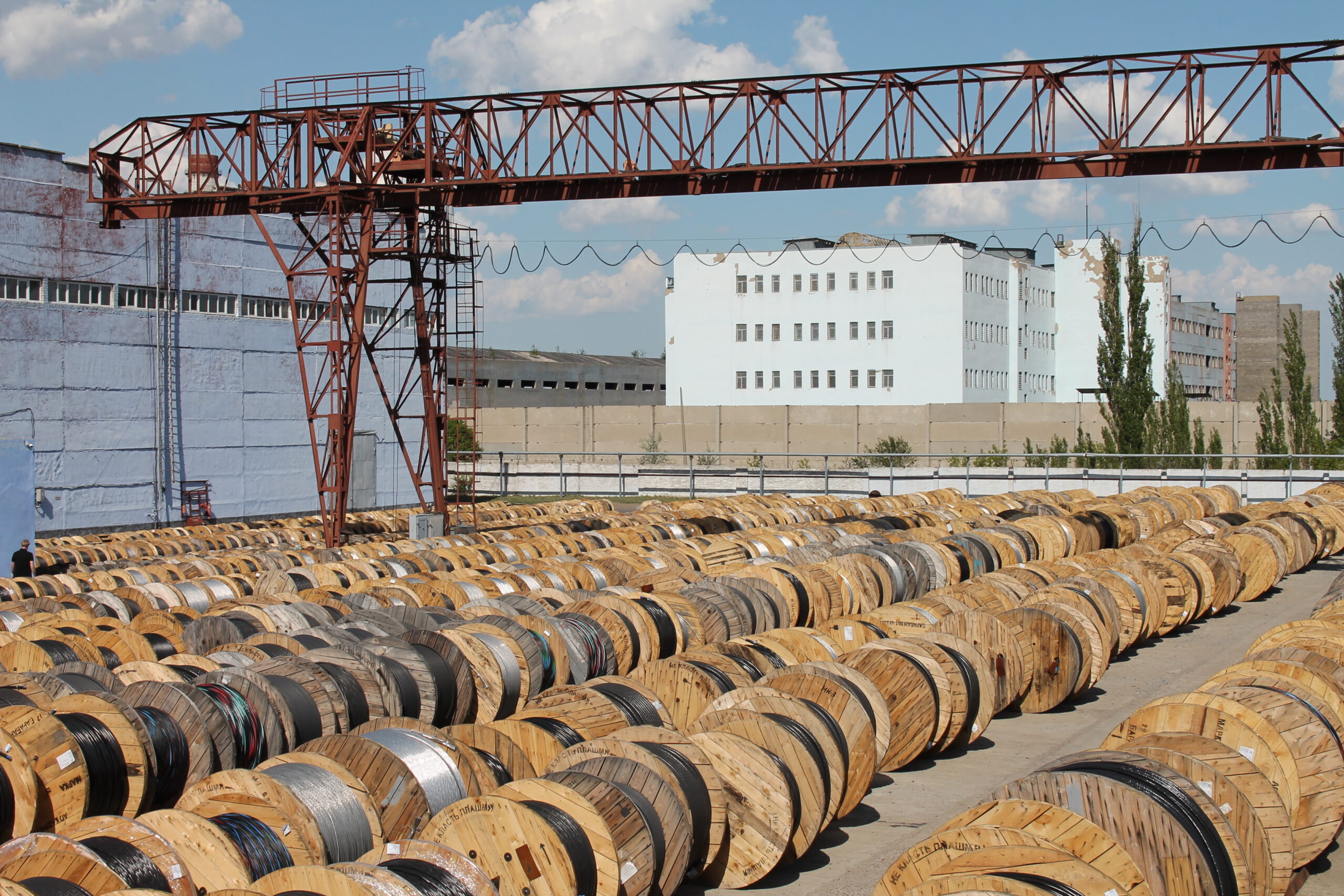
GOST 31996-2012 is an interstate standard that establishes requirements for power cables with plastic insulation for rated voltages of 0.66; 1 and 3 kV. In Kazakhstan, it is applied directly as an interstate standard, put into effect on 1 January 2014, and is in force with Amendment No. 1 (2020) and revisions (2023, 2024). The document replaces the outdated GOST 16442-80 and serves as the main technical reference for manufacturers, designers and procurement specialists when working with cables of the types VVG, VVGng, AVVG, AVBbShv and similar.
What GOST 31996-2012 Regulates
The standard covers the full cycle of requirements for a cable as a finished product: the design of current-carrying conductors, insulation, sheaths, protective coverings, marking, packaging, acceptance rules and control methods. It sets the framework within which the manufacturer must produce the product, and the consumer can verify its compliance with the declared characteristics.
The scope is directly stated in the text: power cables with plastic insulation for the transmission and distribution of electrical energy in fixed installations at AC voltages of 0.66; 1 and 3 kV with a frequency of 50 Hz. These are not cables for rolling stock, not household wires and not communication cables — they have their own standards.
Which Cable Products It Covers
The scope of GOST 31996-2012 includes cables with insulation made of polyvinyl chloride compound (PVC), cross-linked polyethylene, as well as insulation that does not contain halogens. Typical types that are purchased under this standard in Kazakhstan: VVG, VVGng, VVGng-LS, AVVG, AVBbShv, VBShvng-LS, PPGng-FRHF.
The standard applies to both copper and aluminium conductors, as well as conductors made of aluminium alloy. The number of conductors is from one to five. The specific types, their design dimensions and technical conditions are specified in separate technical specifications for cables of specific types, while GOST 31996-2012 sets the general requirements that these specifications must not contradict.
Key Requirements of the Standard
The standard is extensive, but in practice, several groups of requirements are important for a specialist, as they directly affect the selection, installation and operation of the cable.
| Requirement | What it means in practice |
| Current-carrying conductors — class 1 or 2 according to GOST 22483 | Conductors are solid or stranded, with standardised electrical resistance. The class affects flexibility and permissible current. |
| Nominal conductor cross-sections according to Table 1 of the standard | Copper solid — from 1.5 to 50 mm², stranded — up to 1000 mm²; aluminium — from 2.5 to 400 mm². Non-standard cross-sections are not provided for. |
| Insulation made of PVC, cross-linked polyethylene or halogen-free polymer | The insulation type determines the maximum working temperature of the conductor: PVC — +70 °C, cross-linked polyethylene — +90 °C, halogen-free — according to the technical specifications. |
| Requirements for the sheath and protective coverings | The sheath protects the insulation from mechanical and climatic influences. Armoured versions are provided for laying in the ground. |
| Climatic design UHL, KhL, T according to GOST 15150 | The cable must retain its characteristics within the specified ambient temperature range. For Kazakhstan, the UHL and T designs are relevant. |
| Marking and packaging | The sheath indicates the type, number of conductors and cross-section, and voltage. The marking must be preserved during operation. |
| Acceptance rules and control methods | Acceptance and periodic tests: measurement of conductor resistance, insulation breakdown test, verification of geometric dimensions. |
Separately, the standard identifies fire-resistant cables. For them, the current-carrying conductors must be copper, and a thermal barrier of mica-containing tapes is applied over the conductor. Such cables are intended for circuits of fire protection systems, emergency lighting and equipment operating during a fire.
For cables that do not propagate combustion, the standard refers to GOST IEC 60332-3-21, 60332-3-22, 60332-3-23 and GOST 31565-2012. This means that combustion tests are carried out according to the international methods adopted in the EAEU.
What the Standard Does NOT Regulate
GOST 31996-2012 does not establish permissible continuous currents for specific laying conditions. The tables of permissible currents in the PUE RK and GOST R 50571.5.52 are compiled for standardised conditions: air temperature +25 °C, ground +15 °C, single cable. If the actual conditions differ, correction coefficients are introduced, and the final permissible current is recalculated.
The standard does not replace the thermal stability check during a short circuit. A cross-section selected by heating from the working current may fail the short-circuit thermal impulse if the short-circuit current is large and the tripping time is significant. The check is performed separately according to IEC 60364-4-43 and GOST R 50571.4.43.
GOST 31996-2012 does not regulate the selection of cross-section by voltage drop. For lines with a length of 10–15 m and more, voltage drop becomes the decisive factor rather than heating. The methodology for calculating voltage drop is the subject of the PUE RK and separate engineering calculations.
Related Standards and Norms
GOST 31996-2012 works in conjunction with several documents. Without understanding these connections, the standard reads as a formal text rather than a working tool.
| Normative document | How it relates to GOST 31996-2012 |
| TR CU 004/2011 “On the safety of low-voltage equipment” | Mandatory technical regulation of the EAEU. Cables for voltages from 50 to 1000 V AC are subject to conformity assessment in the form of certification. GOST 31996-2012 is included in the list of standards ensuring compliance with the regulation. |
| GOST 22483 | Establishes classes of current-carrying conductors. GOST 31996-2012 requires class 1 or 2. The choice of class affects cable flexibility and termination technology. |
| GOST 31565-2012 | Fire safety requirements for cable products. Determines which cables are classified as non-flame propagating, with low smoke and gas emission, fire-resistant. |
| IEC 60502-1 | International standard for power cables with extruded insulation for voltage of 1 kV. GOST 31996-2012 refers to it as the basic international document. |
| PUE RK | Electrical Installation Code of the Republic of Kazakhstan. Establishes permissible currents, laying coefficients, requirements for protection and earthing. GOST 31996-2012 sets requirements for the cable itself, the PUE — for its application in an electrical installation. |
| GOST 15150 | Climatic designs. Determines at what temperatures and humidity the cable retains operability. |
It is important not to mix requirements from different systems. If the cable is purchased under GOST 31996-2012, but the designer calculates permissible currents according to IEC 60364-5-52, the coefficients and tabulated values are taken from the IEC, not from the PUE. Mixing tables from different normative systems gives an incorrect result.
Practical Application
For the Designer
GOST 31996-2012 defines the list of cross-sections that can be specified in a project. If the designer specifies a cross-section not provided for by the standard, the manufacturer will not be able to produce the cable under GOST 31996-2012, and the customer will face the need to agree on technical specifications. The standard also limits the minimum cross-sections for copper and aluminium conductors: for example, a solid copper conductor — from 1.5 mm², aluminium — from 2.5 mm².
For the Procurement Specialist and Buyer
In the procurement documentation, it is sufficient to specify the type, number of conductors, cross-section and a reference to GOST 31996-2012. This protects against the supply of a cable produced under technical specifications with reduced characteristics. If the supplier offers a cable “according to technical specifications”, it is worth requesting a table of correspondence between the technical specifications and GOST 31996-2012. The difference may concern the thickness of the insulation, the sheath material or the permissible conductor temperature.
For the Installer
The standard normalises the minimum bending radius and permissible tension forces. These parameters depend on the cable design: an armoured cable bends with a larger radius than an unarmoured one. Violation of bending radii leads to damage to the insulation and a reduction in dielectric strength.
For the Test Specialist
The control methods prescribed in GOST 31996-2012 determine which tests are carried out during acceptance and periodically. Conductor resistance is measured according to GOST 22483, the insulation breakdown test — according to the methods specified in the standard. The test results are documented in a report that confirms the conformity of the cable batch.
For the practical selection of a cable for a specific task, not only the requirements of GOST 31996-2012 are important, but also design features. The differences between VVG and VVGng concern primarily behaviour during combustion and smoke emission. The choice between copper and aluminium conductors affects the permissible current and voltage drop. Single-core or multi-core design determines the ease of installation and the flexibility of the line. The general design of a power cable and its characteristics are analysed in a separate material: power cable: design, types, characteristics and areas of application.
FAQ
Is GOST 31996-2012 in force in Kazakhstan?
Yes. The standard has been put into effect on the territory of the Republic of Kazakhstan as a national standard. Amendment No. 1 to GOST 31996-2012 was adopted on the territory of Kazakhstan, which is confirmed by official publications. Cables of types VVG, VVGng, AVVG and others are purchased under this standard within the framework of public procurement.
How does GOST 31996-2012 differ from GOST 16442-80?
GOST 16442-80 is the previous standard for cables with plastic insulation. GOST 31996-2012 replaced it, expanding the scope and refining the requirements for designs, materials and test methods. If a project or procurement specifies GOST 16442-80, this is an outdated reference — the current replacing reference is to GOST 31996-2012.
Does GOST 31996-2012 apply to 10 kV cables?
No. The standard covers voltages of 0.66; 1 and 3 kV. Cables of 6 and 10 kV are regulated by other standards, in particular GOST R 55025-2012 and IEC 60502-2.
What does conductor class 1 or 2 according to GOST 22483 mean?
Class 1 — solid conductors, class 2 — stranded conductors. Solid conductors are stiffer, stranded ones are more flexible. For fixed installation, in most cases class 1 is sufficient; class 2 is used where increased flexibility during installation or vibration is required.
Can a cable according to GOST 31996-2012 be used for laying in the ground?
Yes, but not all types. For laying in the ground, cables with protective coverings are required, for example armoured with steel tapes (types with the index “B” in the designation). An unarmoured cable in the ground is permitted only in pipes or when protected from mechanical damage. The specific laying conditions are determined by the PUE RK.
Normative Sources Used
- GOST 31996-2012 “Power cables with plastic insulation for rated voltages of 0.66; 1 and 3 kV. General technical conditions” — in force, introduced 01.01.2014, with Amendment No. 1 (2020) and revisions (2023, 2024) — https://star-pro.ru/gost/31996-2012
- GOST 22483 — Current-carrying copper and aluminium conductors for cables, wires and cords. Main parameters. Technical requirements — in force — https://docs.cntd.ru/document/1200030695
- GOST 31565-2012 — Cable products. Fire safety requirements — in force — https://docs.cntd.ru/document/1200104304
- TR CU 004/2011 “On the safety of low-voltage equipment” — in force — https://docs.eaeunion.org/docs/ru-ru/0145005
- Decision of the Board of the Eurasian Economic Commission dated 11.05.2023 No. 55 — list of standards for TR CU 004/2011, including GOST 31996-2012 — https://base.garant.ru/406870028/
- IEC 60502-1:2021 — Power cables with extruded insulation and their accessories for rated voltages from 1 kV (Um = 1.2 kV) up to 30 kV (Um = 36 kV) — Part 1: Cables for rated voltages of 1 kV (Um = 1.2 kV) and 3 kV (Um = 3.6 kV) — in force — https://webstore.iec.ch/publication/62612
- Electrical Installation Code of the Republic of Kazakhstan 2015, as amended by the order of the Minister of Energy of the Republic of Kazakhstan dated 31.10.2022 No. 340 — in force — https://base.spinform.ru/show_doc.fwx?rgn=71151