Laying Power Cables: A Complete Guide to Installation, Cross-Section Selection, and Connection
Laying a power cable is a crucial stage in creating any electrical network, from apartment wiring to industrial facilities. The reliability, durability, and trouble-free operation of the entire system depend on how correctly the installation method is chosen, the cross-section of power cables is calculated, and the operating conditions and safety requirements are taken into account. Errors at this stage can lead to short circuits, fires, and failure of expensive equipment.
In this guide, we will detail all the key issues: what installation methods exist, how to choose the voltage of power cables and calculate the cross-section, what materials are used for the sheath of a power cable, what bending of power cables is and why the bending radius is important, as well as how power cable connection to equipment is performed. We will also consider how the weight of the cable affects the choice of supporting structures and provide practical recommendations based on regulatory documents (Electrical Installation Code, GOSTs, SNiPs).
1. Main Methods of Laying Power Cables
The choice of laying method is determined by environmental conditions, the type of route (inside or outside the building), safety requirements, and economic feasibility. According to regulatory documents, several main methods are distinguished.
1.1. Concealed Installation (in chases, walls, under the floor)
This method is most common in residential and civil construction. The cable or wire is fixed in prepared recesses of walls, ceilings, or floors, and then sealed with plaster, screed, or other building materials.
- Advantages:
- Aesthetics — the wiring is completely hidden, does not spoil the interior.
- Protection from mechanical damage and ultraviolet radiation.
- Increased fire safety in buildings made of non-combustible materials.
- Disadvantages:
- High labor intensity of installation and repair. If the cable is damaged, opening the walls is required.
- Difficulty in diagnosing the fault location.
- Limited possibility of cable replacement without destroying the finish.
- Applied cables: For concealed installation indoors, power cable grades VVG, VVGng(A)-LS in flat or round design are ideal.
1.2. Exposed Installation (on walls, in trays, trunking, pipes)
In exposed installation, the cable is laid on the surface of walls, ceilings, or on special supporting structures.
- Exposed installation methods:
- In cable channels (trunking): An aesthetic and convenient method for offices and residential premises, providing easy access to the wiring.
- In electrical trays: Used in industrial facilities and cable routes. Trays allow laying a large number of cables, ensuring their cooling and access.
- In pipes (corrugated HDPE, PVC, steel): Used for additional protection against mechanical damage and moisture, as well as when laying in fire-hazardous areas.
- On walls and building structures: With fastening using staples or clips. Often used in technical rooms.
- On ropes (aerial installation): For long-distance lines through the air, for example, between buildings.
- Advantages:
- Simplicity and relatively low installation cost.
- Easy access for inspection, repair, and cable replacement.
- Convenience of fault diagnosis.
- Disadvantages:
- Less aesthetic appearance.
- Higher probability of mechanical damage.
1.3. Laying in the Ground (trench method)
The main method for outdoor power supply networks in areas where aerial installation is impossible or impractical. Requires strict adherence to rules.
- Types of cables:
- Armored: For laying directly in the ground, cables with armor are used. Steel tape armor protects against mechanical damage, rodents, and rot.
- Non-armored: Cables without armor can be laid in the ground only in protective pipes.
- Basic rules for laying in a trench:
- Trench depth — at least 0.7-0.8 m.
- A sand bed of sifted sand is made at the bottom of the trench.
- The cable is laid in a “wave” pattern with slack for soil movement.
- The cable is covered from above with a layer of sand, then a layer of earth.
- For protection against excavations, a warning tape or a layer of bricks is laid over the sand.
- The distance between several cables in a trench must be at least 10 cm.
- Important: When laying a cable in pipes, it is necessary to ensure there is no tension and no sharp edges that could damage the sheath.
1.4. Underwater Laying
This is a specialized type of laying for crossing water obstacles. Requires the use of cables with a reinforced sealed sheath. Installation can be done manually or mechanically. The depth of the reservoir, flow speed, bottom characteristics, and chemical composition of the water are taken into account.
2. Choosing the Cross-Section of a Power Cable
The cross-section of power cables is perhaps the most important parameter that determines what load the line will withstand. Insufficient cross-section leads to overheating, insulation destruction, and fire. Excessive cross-section leads to unjustified project cost increase.
2.1. What does the conductor cross-section depend on?
- Load current (I): The main calculated parameter. The higher the current, the larger the cross-section should be. Power and current are related by the formula: for a single-phase 220V network I = P / 220, for a three-phase 380V network I = P / (1.73 * 380).
- Conductor material: Copper and aluminum have different conductivity. To transmit the same current, the cross-section of an aluminum conductor must be approximately 1.6 times larger than that of a copper one.
- Installation conditions: The cable’s ability to cool down depends on where it is laid: in the air, in the ground, in a bundle, or singly. For bundle laying, reduction factors are applied.
- Line length: On long lines, a voltage drop occurs, which should not exceed 5%. For long lengths, the cross-section has to be increased.
2.2. Table for selecting the cross-section of copper conductors
| Conductor cross-section, mm² | Current, A (installation in air) | Power, kW (220V) | Typical application |
| 1.5 | 19 | 4.1 | Lighting networks |
| 2.5 | 27 | 5.9 | Socket groups, household appliances |
| 4 | 35 | 7.7 | Electric stoves, hobs, air conditioners |
| 6 | 41 | 9.0 | Input lines to apartments, powerful consumers |
| 10 | 57 | 12.5 | House input, distribution boards |
| 16 | 76 | 16.7 | Risers, lines to powerful equipment |
For aluminum conductors, the current and power values are multiplied by a factor of ~0.65. For laying in the ground, permissible currents are higher; for bundle laying, they are lower. Always pay attention to the cable’s compliance with GOST 31996-2012.
3. Voltage of Power Cables: Classes and Marking
The voltage of power cables is the rated voltage for which their insulation is designed. Exceeding this voltage is unacceptable.
- 0.66 kV: The most common class for internal networks with voltages up to 380V.
- 1 kV: Used in industry and for building entrances, have an increased safety margin of insulation.
- 6, 10, 35 kV and above: Medium and high voltage cables. Used for powering neighborhoods, factories, in main networks. These are usually cables made of cross-linked polyethylene or with paper insulation. For example, copper power cable or aluminum cable with cross-linked polyethylene insulation for 10 kV voltage.
4. Power Cable Sheath: Materials and Purpose
The power cable sheath protects the internal elements from moisture, chemical influences, mechanical damage, and determines fire safety.
- PVC compound (V): The most common material. Provides good electrical insulation, resistant to aggressive environments. Can be:
- ng: Does not propagate combustion.
- LS: With reduced smoke and gas emission. LS power cables are mandatory for places with mass gathering of people.
- Polyethylene (P, Pv): Has higher moisture resistance and resistance to UV radiation than PVC. Used for outdoor installation and in the ground.
- Rubber (R): Provides flexibility and frost resistance. Used in flexible cables.
- Armor (B, Bb): Steel galvanized tapes or wire, over which a protective hose is applied. Armored cables are intended for laying in the ground.
5. Bending Power Cables: Permissible Bending Radii
Bending power cables is an operation that requires caution. Excessive bending can lead to damage to the conductors or insulation. The minimum permissible bending radius is standardized by the manufacturer and depends on the design.
- For non-armored multi-core cables: at least 7.5-10 outer diameters of the cable.
- For single-core cables: at least 10-15 diameters.
- For armored cables: at least 12-15 diameters.
- For flexible cables: a smaller bending radius is allowed, as they are specially designed for frequent movements.
During installation, use special templates or corners to avoid sharp bends, especially at entry points into panels and equipment.
6. Power Cable Connection: Basic Rules
Power cable connection to equipment must ensure reliable electrical contact and the required level of protection.
- Cable stripping: The outer sheath and insulation are removed from the conductors to the required length. It is important not to damage the conductor metal when stripping the insulation.
- Termination:
- For connection under a screw or in terminals, stranded conductors are recommended to be crimped with lugs or tinned sleeves to prevent wire breakage.
- For powerful cables, cable lugs for crimping or welding are used.
- Color marking: Strictly observe the colors: yellow-green — protective grounding, blue or light blue — working neutral, black, brown, gray — phases.
- Connection of copper and aluminum: Direct twisting is unacceptable due to the formation of a galvanic pair and oxidation. Use terminal blocks or copper-coated aluminum lugs.
- Entry into panels: The entry point must be sealed to prevent dust and moisture ingress. Use glands, seals, or entry plates.
7. Power Cable Weight: What does it affect?
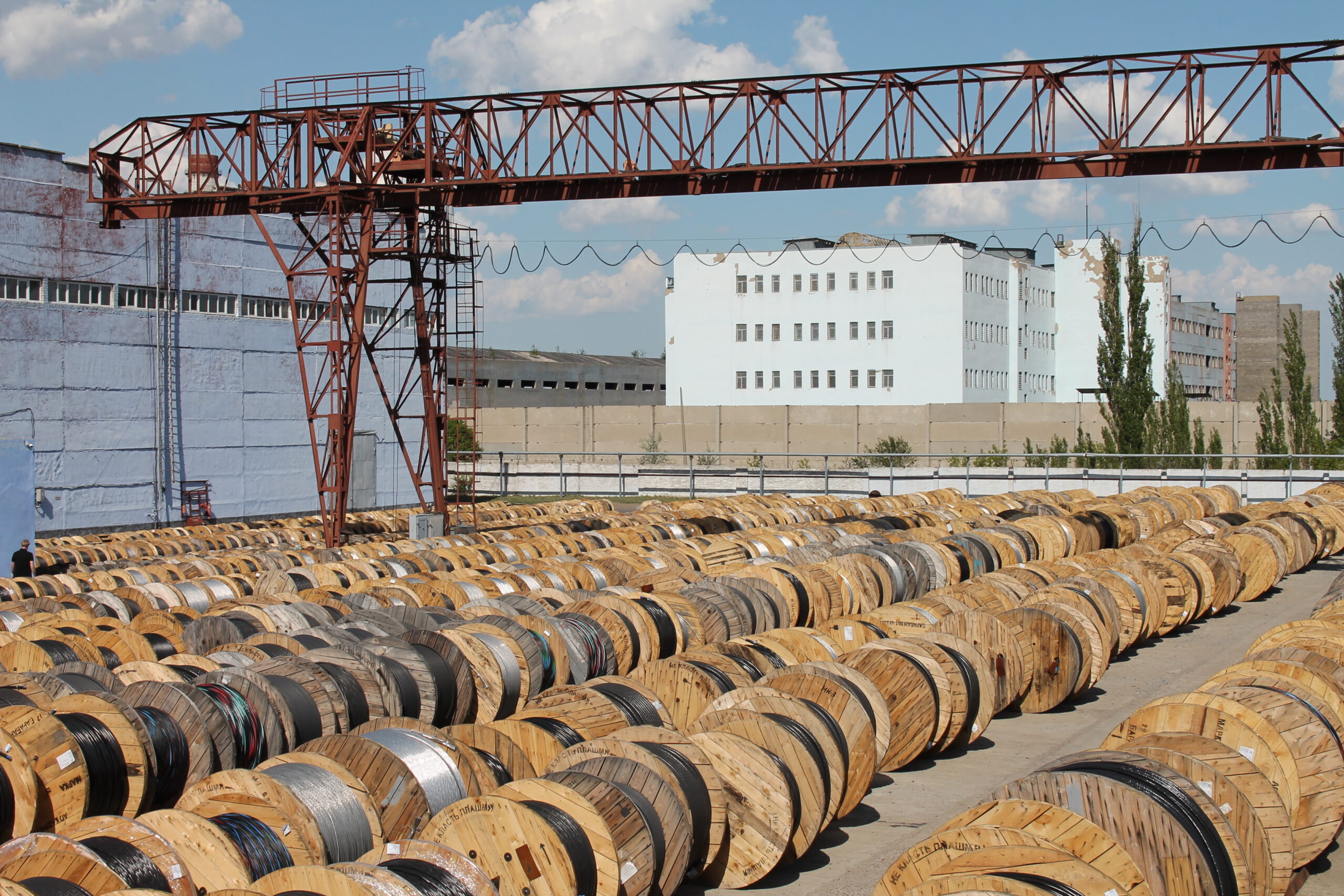
Power cable weight is an important parameter when designing supporting structures, choosing drums, and calculating transportation costs. The weight of the cable depends on the material and cross-section of the conductors, the thickness of the insulation and sheath, and the presence of armor. The specific weight of the cable is indicated in the manufacturer’s catalogs and is necessary for ordering lifting and transport mechanisms and calculating loads on cable structures.
8. Conclusion
Competent laying of a power cable is a complex task requiring consideration of many factors: from choosing the installation method and correctly calculating the cross-section of the copper power cable or its aluminum equivalent to observing the rules of power cable connection and fire safety standards. Only an integrated approach guarantees reliable and durable power supply for your facility.
The range of cable and wire products from JSC “Kazenergokabel” includes all necessary types of power cables for any installation method: popular VVGng(A)-LS for internal work, armored VBbShv for laying in the ground, flexible KG for connecting mobile mechanisms, as well as specialized cables with cross-linked polyethylene insulation for voltages of 6-35 kV. All products are certified and comply with the requirements of GOST and CU TR, guaranteeing the safety and durability of your electrical networks.