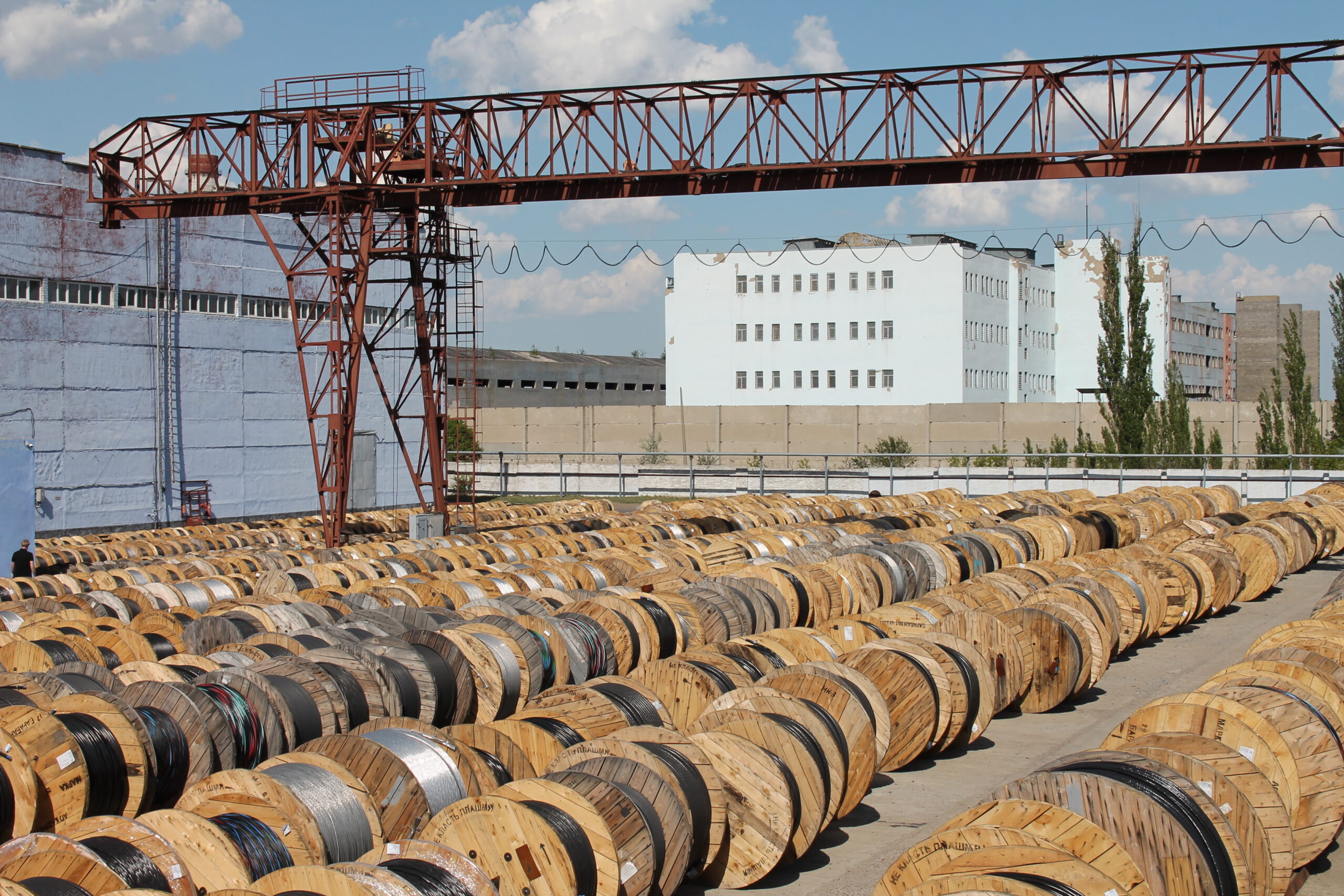
Introduction: KVVG and KVVGE
Control cables serve to transmit control, monitoring and measurement signals in circuits with voltages up to 660 V or 1000 V AC. Two mass‑produced types — KVVG and KVVGE — differ in a single detail: the presence of an overall screen. KVVG is a control cable with copper conductors, PVC insulation and a PVC sheath, without a screen. KVVGE has the same construction, but supplemented with an overall screen of copper tape or foil with a drain wire.
The choice between them is dictated by the electromagnetic environment at the facility. If the route runs far from power lines and sources of interference, KVVG is sufficient. If powerful drives, frequency converters or power cables run in parallel nearby, the screen of KVVGE protects the measurement circuits from interference. Detailed requirements for control circuits and installation are given in the review all about control cables and in the guide laying control cables.
Comparative Table of Characteristics
| Parameter | KVVG | KVVGE |
| Marking meaning | Control, with PVC insulation, PVC sheath, without armour and screen | The same, letter “E” — overall screen of copper tape/foil |
| Screen | Absent | Overall screen with drain wire |
| Protection against electromagnetic interference | Minimal, only due to conductor twisting | High, the screen reflects external fields and reduces cross‑talk |
| Earthing | Not required | Mandatory earthing of the screen at one or both ends |
| Range of conductor cross‑sections | 0.75; 1.0; 1.5; 2.5 mm² | 0.75; 1.0; 1.5; 2.5 mm² |
| Number of conductors | 2, 3, 4, 5, 7, 10, 14, 19, 27, 37 | Identical range |
| Rated voltage | 660 V or 1000 V (by marking) | 660 V or 1000 V |
| Insulation and sheath | PVC compound, possible ng(A)‑LS version | PVC compound, ng(A)‑LS versions |
| Outer diameter | Smaller due to the absence of a screen | Larger, a foil layer and drain wire are added |
| Weight per metre | Lower | Higher due to the copper screen |
| Bending radius | Not less than 6 outer diameters | Not less than 6 outer diameters, but rigidity is higher |
| Cable cost | Lower | 15–30 % higher |
| Main scenarios | Control circuits in a calm EM environment | Routes next to power lines, sensors with low signal |
Design Features and Marking
Both types are based on copper conductors of classes 1 or 2 according to GOST 22483. The insulation is colour or numbered, the sheath is PVC. In KVVGE, a layer of aluminium‑polymer tape or copper foil with a contact drain wire of tinned copper is added between the twisted conductors and the sheath. The drain ensures the continuity of the screen and facilitates its earthing during termination.
The marking includes the type designation, the number of conductors and the cross‑section, e.g., KVVGE 10×1.5. Additional indices: ng — does not propagate combustion, LS — low smoke emission. Control cables with the A LS index (ng(A)‑LS) are fire‑safe and suitable for installation in public buildings. Fire‑resistant versions FRLS are used in fire‑protection automation systems. All parameters are regulated by GOST 26411‑85, as well as by the earlier GOST 1508‑78 for individual cross‑sections. The exact values of the outer diameter and the weight per metre are given in the manufacturers’ documentation. The catalogue KVVG cable presents both versions.
Screen and Noise Immunity
The screen of KVVGE is a key advantage in the presence of electromagnetic fields. Inverters, frequency converters, and electric motors generate interference that is induced into unshielded conductors and distorts low‑current signals. The copper foil or tape of the screen absorbs and reflects this interference, protecting the measurement circuits. The drain wire diverts the induced currents to earth.
Without earthing, the screen loses effectiveness and can itself serve as an antenna. When installing KVVGE, it is mandatory to earth the drain at one end, and for high‑frequency interference — at both ends. On long routes, a break in the screen is sometimes required to avoid earth loops. KVVG is free of these requirements, but it also provides no protection against interference. In clean conditions with power cables separated by the standard 200–300 mm, an unshielded control wire operates stably.
Technical Characteristics, Cross‑Sections and Permissible Currents
Control cables KVVG and KVVGE are manufactured with conductor cross‑sections of 0.75; 1.0; 1.5; 2.5 mm². The range of conductor counts: 2, 3, 4, 5, 7, 10, 14, 19, 27, 37. Typical orders: 3×1, 3×1.5, 4×1, 4×1.5, 4×2, 4×2.5, 4×4 (although 4 mm² is rarer, usually up to 2.5), 5×1, 5×1.5, 7×1, 7×1.5, 10×1, 10×1.5, 10×2, 10×2.5, 14×1, 14×1.5, 19×1. The cable 10×1.5 is one of the popular ones for connecting sensors and actuators. The maximum cross‑section for control circuits is usually 2.5 mm², since the currents in control circuits are small.
The continuous permissible currents for copper conductors of control cables with PVC insulation, laid in air, are approximately: 0.75 mm² — up to 15 A; 1.0 mm² — 17 A; 1.5 mm² — 23 A; 2.5 mm² — 30 A. For bundled laying in trays, the values decrease according to the PUE. The outer diameter depends on the number of conductors and the presence of a screen; for KVVGE 10×1.5 it is about 15–17 mm, the weight per metre is about 450 g. For KVVG of the same cross‑section, the diameter is 2–3 mm smaller, and the mass is 10–15 % lower. The exact figures are clarified from the manufacturer’s passport.
Typical Cross‑Sections and Number of Conductors
| Type | Frequently ordered versions | Cross‑section range, mm² | Number of conductors |
| KVVG | 3×1, 4×1.5, 5×1, 7×1.5, 10×1.5, 14×1.5, 19×1 | 0.75–2.5 | 2–37 |
| KVVGE | 3×1, 4×1, 5×1.5, 10×1.5, 14×1, 19×1 | 0.75–2.5 | 2–19 (less often up to 37) |
When to Choose KVVG
- Control circuits inside switchboards and consoles, where power conductors are separated and the interference level is low.
- Laying on cable structures at a considerable distance from inverters, frequency converters and welding equipment.
- Lighting, ventilation, heating systems where high accuracy of analogue signals is not required.
- Facilities where budget savings are important and slight interference is permissible. The price of KVVG is noticeably lower, and the absence of a screen simplifies termination.
- Fire alarm and voice evacuation networks when using a fire‑resistant FRLS version, if the cable does not intersect with power mains in common boxes.
When KVVGE Is Needed
- Connection of analogue sensors with millivolt and milliamp signals: thermocouples, resistance thermometers, strain gauges. Interference of a fraction of a volt distorts the readings.
- Routes running parallel to power cables for more than 5–10 metres. The screen reduces cross‑talk to an acceptable level.
- Industrial sites with powerful electric motors, frequency converters, induction furnaces. KVVGE preserves signal integrity.
- Facilities where electromagnetic compatibility according to GOST R 51317 and IEC standards is required. A screened cable is a mandatory condition.
- Dispatching and process control systems (SCADA) where data loss or false operation is unacceptable.
Typical Mistakes in Selection and Installation
- Installing KVVGE without earthing the screen. This turns the foil into an antenna, increasing the interference level rather than reducing it.
- Purchasing KVVGE for circuits where there is no electromagnetic interference — an unjustified increase in cost and complication of installation.
- Laying an unshielded KVVG in the same tray with a power cable without a metal partition. Interference leads to controller malfunctions.
- Using a control cable with a PVC sheath outdoors without protection from ultraviolet radiation. The compound degrades in 2–3 seasons.
- Ordering a cable with a “just enough” number of conductors, without a reserve. If one conductor fails, the entire line requires replacement. It is recommended to provide a 15–20 % reserve.
- Failure to observe the bending radius. For KVVGE, it must be at least 6 diameters; during a sharp bend, the screen breaks and loses continuity.
Frequently Asked Questions
How to decipher the marking KVVGE 10×1.5 ng(A)‑LS?
K — control, V — PVC insulation, V — PVC sheath, G — without armour, E — screen. 10×1.5 — ten copper conductors with a cross‑section of 1.5 mm². ng(A) — does not propagate combustion in category A, LS — with reduced smoke and gas emission.
What is the difference between KVVG and VVG?
KVVG is a control cable, intended for control and alarm circuits with a voltage of up to 660/1000 V. VVG is a power cable for distribution networks of 0.66/1 kV. KVVG has a wider range of conductor counts and smaller cross‑sections. In a power cable, the conductors usually have a cross‑section from 1.5 mm², in a control cable — from 0.75 mm².
Can a control cable be used in power circuits?
It is not recommended. Control cables are not designed to transmit large currents; their insulation is tested for other voltages. An exception is temporary low‑power networks provided the PUE is complied with.
What is the weight per metre of KVVGE 10×1.5?
Approximately 450–480 g. The exact value depends on the manufacturer. For KVVG 10×1.5, the mass is about 380 g.
Is a certificate required for KVVG?
Yes, a certificate of conformity to GOST 26411 or technical specifications is mandatory, as well as a fire certificate for ng‑LS and FRLS versions.
What is the difference between KVVG and KVVGE with the same cross‑section?
Only the screen. The electrical resistance of the conductors and the permissible current are the same. The difference is in interference protection, outer diameter, weight and price.
Conclusion
The control cable KVVG is a standard solution for control circuits in an electromagnetically calm environment. KVVGE adds a screen that protects signals from interference and is required when laying next to power lines, as well as for precise measurements. Both types are manufactured with copper conductors of a wide range of cross‑sections and conductor counts, including 3×1, 4×1.5, 5×1.5, 7×1, 10×1.5, 14×1, 19×1, as well as in fire‑safe ng(A)‑LS and fire‑resistant FRLS versions. When selecting, one relies on GOST 26411 and the actual route conditions. The range of control cables is presented in the catalogue KVVG cable with detailed characteristics and certificates.