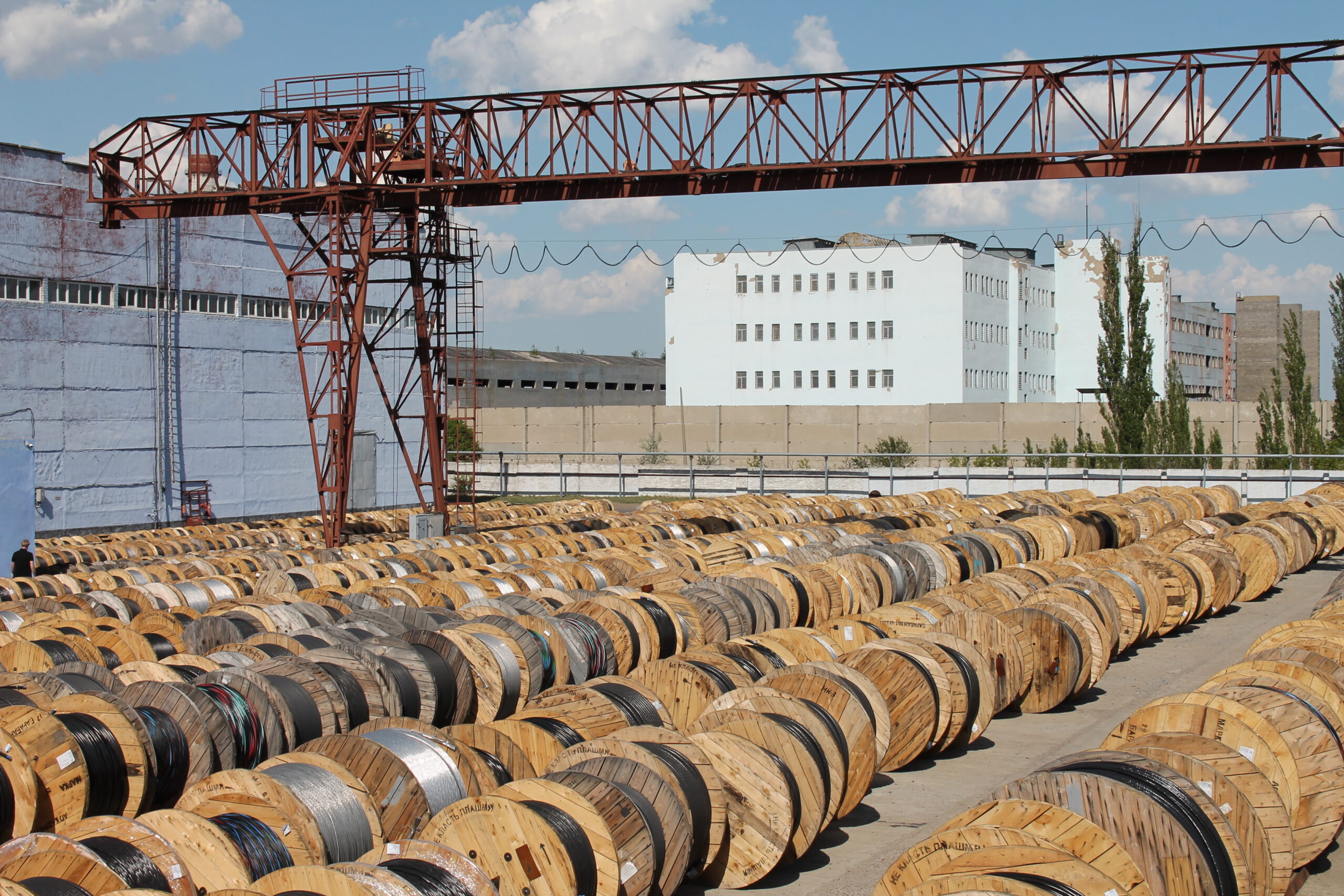
TPP Communication Cable: Complete Guide to Application and Selection
Communication cable is a specialized conductor designed for transmitting telecommunication signals (telephone, telegraph, data) over long and short distances. The key representative of this class is the TPP cable (telephone cable with polyethylene insulation in a polyethylene sheath) — the main “workhorse” cable for organizing subscriber lines and communication trunks. Its primary task is to ensure high-quality and stable transmission of low-frequency communication signals with minimal losses and protection from external influences. These cables form the “circulatory system” of urban and rural telephone networks, alarm systems, and dispatch systems.
1. Main Tasks and Application Areas
Communication cables, particularly TPP, are used to create permanent communication lines between telephone exchanges, distribution cabinets, and end subscribers. Main application areas:
- Urban and Rural Telephone Networks (UTN, RTN): Laying subscriber lines from telephone exchange cross-connect racks to building distribution boxes and then into apartments. Creating connecting lines between telephone exchanges.
- Fire and Security Alarm Systems (FSA): Organizing alarm loops to transmit signals from detectors to control panels.
- Dispatch Communication and Public Address Systems: Equipping intercom devices, public address systems at industrial facilities, railway stations, subways.
- Low-Speed Data Transmission Channels: Can be used for modem communication, organizing channels for telemetry systems and AMR (Automated Meter Reading) systems.
- On-Site Communication Lines: Telephone network wiring inside administrative buildings, business centers, offices (although UTP is now more commonly used for this purpose).
- Backup and Temporary Communication Lines: Due to resistance to weather conditions, it can be used for rapid communication restoration.
2. Construction, Materials, and Classification According to GOST
The construction of TPP cable is optimized for long-term operation in various installation conditions. The main elements and requirements are regulated by GOST 31943-2012 “Telephone distribution and subscriber communication cables with hydrophobic filling. General specifications”.
| Construction Element | Materials and Options per GOST | Purpose and Influence on Properties |
| Conductor | Copper wire with diameter 0.4, 0.5, 0.7 mm (0.5 mm is most common). Can be solid (for stationary installation) or stranded (for increased flexibility). | Provides signal transmission. Conductor diameter directly affects the series resistance and the maximum communication distance without amplifiers. |
| Conductor Insulation | High or low-density polyethylene (PE). Colored (for pair identification in the lay) or single-colored. | Electrically insulates conductors from each other. Polyethylene provides stable dielectric characteristics, low moisture absorption, and durability. |
| Twisting (Forming Pairs) | Two insulated conductors are twisted with a specific pitch. Pairs are then twisted into layers (usually around a central core). | Twisting pairs is the primary method of reducing mutual influences (crosstalk) between circuits within the same cable. The twist pitch differs for different pairs. |
| Core Wrap and Filling | Hydrophobic filler (petrolatum, gel) and polyethylene or PVC tape. | Hydrophobic filling is a key feature! Prevents moisture from penetrating and spreading along the cable if the sheath is damaged, maintaining line operability. |
| Shield (if present) | Aluminum-polymer tape, corrugated steel tape, copper braid. Denoted by the letter “E” in the marking. | Protects transmitted signals from external electromagnetic interference (e.g., from power lines, tram lines) and reduces radiation. More commonly used in trunk cables. |
| Outer Sheath | Polyethylene (PE) for outdoor installation (denoted by the letter “P” in the second position of the marking) or PVC (V) for indoor use. | The polyethylene sheath provides high resistance to moisture, UV radiation, temperature fluctuations, and mechanical stress, making TPP cable suitable for installation in the ground (in ducts), aerially, and on building walls. |
3. Marking Decoding and Main Types of TPP Cables
The marking of communication cables in Russia follows a unified system established in GOST 31943. Let’s break down the TPP marking and its modifications.
| Cable Marking | Decoding of Marking | Key Characteristics and Application |
| TPP | Telephone, with Polyethylene insulation of conductors, in Polyethylene sheath. Without hydrophobic filling in early versions. | Classic cable for installation in telephone ducts, on building walls, aerially on poles. Resistant to moisture and UV radiation. Standard for subscriber communication lines. |
| TPPep (e.g., TPPep 10x2x0.5) | Telephone, Polyethylene insulation, Polyethylene sheath, electromagnetic shield (foil), petrolatum filling (hydrophobic) under the sheath (explained in GOST 31943-2012). | The modern, most advanced, and widespread construction. The shield protects against interference, and the hydrophobic filling (“moisture protection”) dramatically increases the reliability and service life of the cable, especially for underground installation. This is the type most often meant today by the query “TPP communication cable“. |
| TPPz | Telephone, Polyethylene insulation, Polyethylene sheath, zapolnenny (filled with hydrophobic filler). | Analog of TPPep, but without the shielding layer. Used where there are no strong electromagnetic interferences, but protection from moisture is required. |
| TVP (obsolete) | Telephone, with Vinyl (PVC) insulation, in Polyethylene sheath. | Had PVC conductor insulation, which is less stable in terms of electrical parameters. Almost entirely replaced by cables with polyethylene insulation (TPP). |
| Armored Cables (TPPB, TPPBl) | Letter B — armor made of steel tapes, Bl — armor made of galvanized steel wires. | Used for direct burial in the ground (trenches) without protective pipes in conditions with a high risk of mechanical damage (rocky soils, construction zones). |
The primary document defining the technical requirements for these cables is GOST 31943-2012. When purchasing, it is important to ensure that the product complies with this standard.
4. Criteria for Selecting TPP Communication Cable
Choosing the specific brand, construction, and parameters is the foundation for building a reliable communication line.
| Selection Criterion | What to Consider and Check | Practical Recommendations |
| Number of Pairs | From 5 to 600 or more pairs. Most common: 10×2, 20×2, 30×2, 50×2, 100×2. | Selected based on the planned number of subscribers + reserve (usually 20-30%). For subscriber distribution, TPP cable 10x2x0.5 or 20x2x0.5 is most often used. |
| Conductor Diameter | 0.4 mm (for short lines), 0.5 mm (standard), 0.7 mm (for long lines, reduces attenuation). | 0.5 mm is the universal and most popular option. 0.7 mm is chosen for trunk sections longer than 3-5 km to reduce losses. |
| Presence of Shield and Hydrophobic Filling | Level of external interference and installation conditions (underground, aerial, risk of damage). | For most modern projects, TPPep is recommended. The filling (“moisture protection”) dramatically increases reliability. A shield is mandatory when laying near power lines. |
| Installation Conditions (Route) | In cable ducts, in the ground, aerially, inside buildings. | • For ducts, aerial, ground (in pipes): TPPep with polyethylene sheath. • For direct burial without pipes: TPPB (armored). • Inside buildings: cable with PVC sheath is possible (but polyethylene is also acceptable). |
| Compliance with GOST | Presence of marking GOST 31943-2012 in the documentation and on the drum. | Cable manufactured according to GOST guarantees the stated electrical parameters (conductor resistance, mutual capacitance, insulation resistance) and durability. This is critically important for stable communication. |
| Inspection Upon Purchase | Color coding of pairs, sheath integrity, presence of data tags. | Check the marking on the sheath: it should clearly indicate the manufacturer, brand (e.g., TPPep), length, date of manufacture, and GOST number (GOST 31943). |
When analyzing queries like “communication cable price” or “buy communication cable price“, it’s important to understand that the cost is determined by the number of pairs, conductor diameter, presence of shield/filling, and, most importantly, compliance with GOST. Saving on non-certified cable leads to increased attenuation, reduced reliability, and frequent line failures.
5. Features of TPP Cable Installation and Stripping
- Paying Out and Tension: Do not allow excessive tension on the cable. Pay out from the drum, do not pull off in rings. Minimum bending radius — not less than 10-15 times the outer diameter of the cable.
- Working with Hydrophobic Filling: When stripping the end of a TPPep/TPPz cable, be prepared for the presence of filler (gel or petrolatum). It must be carefully removed from the conductor ends before connecting to terminals, using special cleaners or a lint-free cloth.
- Pair Marking: Strictly adhere to the standard color coding of pairs (white-blue, white-orange, etc.) when switching at cross-connect racks or sockets. This is necessary for subsequent maintenance and fault finding.
- Shield Termination: If the cable is shielded (TPPep), the shield (foil) must be grounded at the switching point for effective protection against interference.
- Direct Burial: For trenchless installation, be sure to use armored modifications (TPPB). Sand bedding and covering, laying warning tape are mandatory stages of work.
6. Conclusion
Choosing the right communication cable, particularly the time-tested TPP construction, is a fundamental decision for creating a stable and high-quality communication infrastructure. The range, clarity of communication, and, most importantly, the reliability of the connection in any weather conditions depend on the cable’s characteristics. Using modern modifications with hydrophobic filling and a shield, such as TPPep, and strict compliance with GOST 31943-2012 are not additional options, but a necessary standard for professional networks.
Purchasing certified cable products from reliable manufacturers, such as JSC “Kazenergokabel”, guarantees compliance with all standard requirements and a long service life for communication lines. The full range of cable and wire products for any task is presented in our catalog.