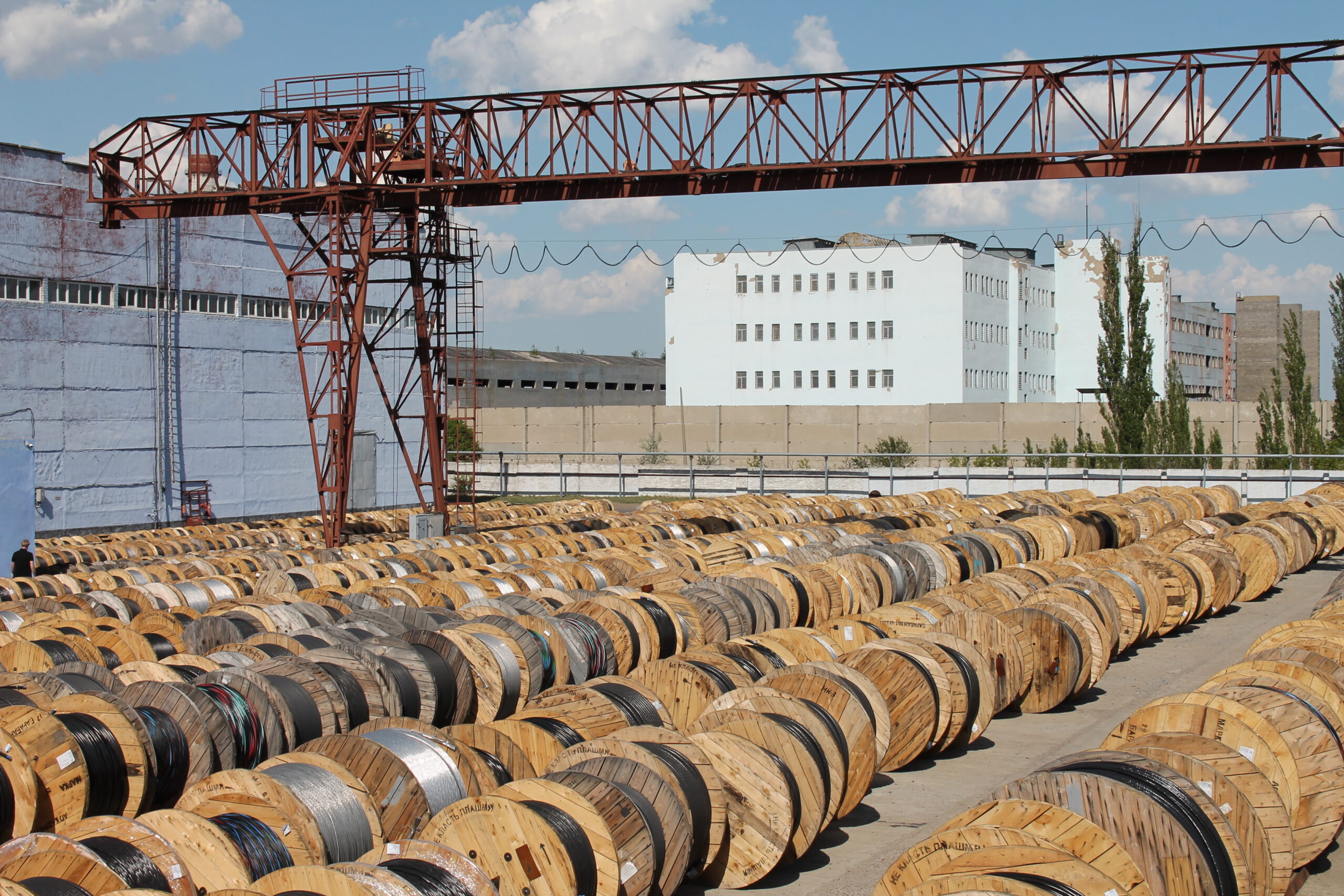
Signal Cable: Complete Guide to Selection and Application
Signal cable is a specialized cable designed for transmitting information, control commands, and measurement signals (analog and digital) in automation, communication, alarm, and monitoring systems. Unlike power cables that transmit electrical power, the primary task of a signal cable is to ensure the integrity and accuracy of a low-voltage signal over distance, minimizing distortion and interference. These cables are the “nervous system” of modern industrial automation systems, security systems, telemechanics, and communication networks.
1. Main Tasks and Application Areas
Signal cables are used to create connections between sensors, controllers, actuators, and operator workstations. Main application areas:
- Industrial Automation (APCS): Connecting temperature, pressure, flow, and level sensors to programmable logic controllers (PLCs). Transmitting commands to contactors, valves, and variable frequency drives.
- Fire and Security Alarm Systems (FSA): Forming loops and communication lines for detectors, control panels, and annunciators.
- Communication Systems and SCS: Organizing internal telephone networks, data transmission networks (although UTP/FTP are more commonly used today for high-speed data).
- Telemechanics and Dispatching: Communication between remote objects (pumping stations, electrical substations) and a dispatch center.
- CCTV (Video Surveillance): Transmitting video signals from analog cameras to video recorders (coaxial cables) or power and data for IP cameras (twisted pair).
- Public Address Systems (PAS): Connecting loudspeakers and amplifiers.
2. Classification, Construction, and Materials
The construction of a signal cable is optimized to protect the low-current signal. Main elements:
| Construction Element | Materials and Options | Purpose and Influence on Properties |
| Conductor | Copper (copper conductor — standard), less commonly copper-clad steel for cost reduction. Can be solid (for fixed installation) or stranded (for flexible connections). | Ensures signal transmission. Conductor cross-section (from 0.35 to 2.5 mm²) is selected based on line length and resistance. Copper provides the best conductivity. |
| Conductor Insulation | Polyvinyl chloride (PVC), polyethylene (PE), cross-linked polyethylene (XLPE), foamed polyethylene to reduce capacitance. | Electrically insulates conductors from each other. The material affects cable capacitance, dielectric loss, and temperature resistance. Foamed insulation improves high-frequency characteristics. |
| Shield (critically important element) | Foil (aluminum foil with drain wire), braid (copper or galvanized wire), combined (foil + braid). | Protects the transmitted signal from external electromagnetic interference (EMI) and prevents radiation of interference from the cable itself. Mandatory for analog and high-speed digital signals, especially when laid near power lines. |
| Pair Twisting (Twisted Pair) | Two insulated conductors twisted together with a specific pitch. | The primary method for combating common-mode interference. Used in cables for digital interfaces (RS-485, Ethernet), alarm systems. |
| Core Wrap and Filler | PET or PVC tapes, or an extruded layer. | Gives the cable a round shape, provides mechanical stability, and additional protection. |
| Outer Sheath | PVC compound (standard, ng, LS), polyethylene (for outdoors), polyurethane (for flexibility and wear resistance). | Protects the cable from mechanical damage, moisture, oils, UV radiation. The material determines the installation conditions (indoor/outdoor, group mounting). |
3. Main Types of Signal Cables and Their Marking Decoding
The marking of signal cables in Russia often follows a logic similar to power cables but with specific designations. Let’s look at the key types, including popular search queries.
| Cable Type | Marking Decoding and Construction | Key Characteristics and Application |
| KSPV, KSPEV | Kommunikatsionny (Communication) Signalny (Signal) cable, with Polyethylene insulation, in Vinyl (PVC) sheath. “E” — Ekran (Shield). Single-pair or multi-pair. | Classic cable for alarm and communication systems. KSPEV (shielded) is used for analog fire alarm loops, telephone lines. |
| SBVG | SB — Signalno-Blokirovochny (Signal and Interlocking), V — PVC insulation and sheath, G — Gibky (Flexible, literally “bare” meaning without armor). Copper conductors, shield (braid or foil). | Universal cable for telemechanics, alarm, and control systems. Used indoors. SBVG cable is the basic model. |
| SBVGng | The same SBVG, but with a sheath that ne gorit (does not propagate combustion). | For group installation in cable trays, ducts, shafts. Mandatory for bundle mounting in buildings. SBVGng cable is the modern standard. |
| SBZPU, SBPU | SB — Signalno-Blokirovochny (Signal and Interlocking), Z — copper wire braid shield (ekran), P — Polyethylene insulation, U — Usilennaya (Reinforced) sheath (polyethylene or PVC). | Cables for outdoor installation. Polyethylene sheath is resistant to UV and moisture. Braid shield provides good protection against interference and mechanical strength. SBPU cable is often used for long outdoor routes. |
| SBVBbShvng | SB — Signalno-Blokirovochny (Signal and Interlocking), V — PVC insulation, Bb — armor made of two steel tapes, Shv — protective PVC hose (sheath), ng — non-flammable. | Armored cable for laying in the ground (trenches), in places with risk of mechanical damage. SBVBbShvng cable is used for inter-site connections in industrial plants. |
| SBPBG | SB — Signalno-Blokirovochny (Signal and Interlocking), P — Polyethylene insulation, B — Bronya (Armor), G — without protective cover over the armor. | Similar to SBVBbShv, but without an outer jacket. The armor serves also as a shield. For dry rooms where there is no aggressive environment. |
Requirements for many signal cables with PVC insulation are regulated by GOST 31995-2012 “Power cables with plastic insulation for rated voltages 0.66; 1 and 3 kV”.
4. Criteria for Selecting a Signal Cable
Choosing the specific type and parameters is a key stage in designing a reliable system.
| Selection Criterion | What to Consider and Check | Practical Recommendations |
| Type of Signal Transmitted | Analog (4-20 mA, 0-10 V) or digital (RS-485, Ethernet, discrete), frequency, transmission speed. | For analog signals and digital protocols (RS-485), a shield and twisted pair are mandatory. For high-speed Ethernet, use Category 5e/6 cables. |
| Presence and Type of Shield | Level of electromagnetic interference in the installation area. Proximity to power cables, variable frequency drives. | When laying parallel to power cables, use only shielded cable (foil + braid). In “clean” rooms for discrete signals, unshielded cable can be used. |
| Installation Conditions (Route) | Indoors/outdoors, in the ground, in trays in bundles, presence of mechanical risks. |
|
| Fire Safety Requirements | Bundle installation (group), premises with large numbers of people. | For group installation, a sheath with the index ng (non-combustible) is mandatory. For subways, tunnels, hospitals — ng-LS (low smoke emission). |
| Line Length | Conductor resistance and cable capacitance per unit length. | For long lines (over 100 m) for 4-20 mA analog signals, choose a larger conductor cross-section (1.0 mm² or 1.5 mm²) to reduce voltage drop. For digital (RS-485), consider characteristic impedance. |
| Flexibility | Moving connections, frequent bending during installation. | For fixed installation — class 1 conductor (solid). For connecting to moving sensors, doors — class 5 conductor (stranded). |
When analyzing queries like “buy signal cables” or “signal cable price“, it’s important to remember that the price is determined by the cost of copper, the presence of a shield, armor, and the type of sheath. Saving on the shield or the “ng” sheath can lead to system failure or violation of fire safety regulations.
5. Features of Installation and Connection
- Laying Near Power Cables: If crossing is unavoidable, it should be done at a 90-degree angle. For parallel runs, the distance should be at least 50 cm, and if laid in the same tray, use a separating partition.
- Terminating the Shield: The shield must be grounded, but generally, only on one side (usually the controller or PLC side) to avoid creating a ground loop and inducing equalizing currents. Use shielded terminal blocks or clamps for this.
- Minimum Bending Radius: Specified by the manufacturer (usually not less than 5-10 times the outer diameter). Violation leads to deformation of the shield and insulation.
- End Marking: All cores must be marked at both ends according to the connection diagram.
- Outdoor Protection: When transitioning from indoors to outdoors, the cable must pass through a sealed gland, and the outdoor section itself should be protected by a corrugated pipe or laid in the ground if possible.
6. Conclusion
Choosing the right signal cable is not a secondary task but a fundamental element in designing a reliable control or communication system. Data integrity, measurement accuracy, and ultimately the stability of the technological process or facility security depend on it. Using specialized types, such as the universal SBVGng for indoors or the environmentally resistant SBZPU for outdoors, in accordance with operating conditions and regulatory requirements, is the key to long-term and trouble-free operation.
Purchasing high-quality cable products from trusted manufacturers, such as JSC “Kazenergokabel”, guarantees compliance with stated characteristics and standards, eliminating risks and unexpected costs in the future.