Optical Cable: Construction, Fiber Types, Types, Installation and Measurements
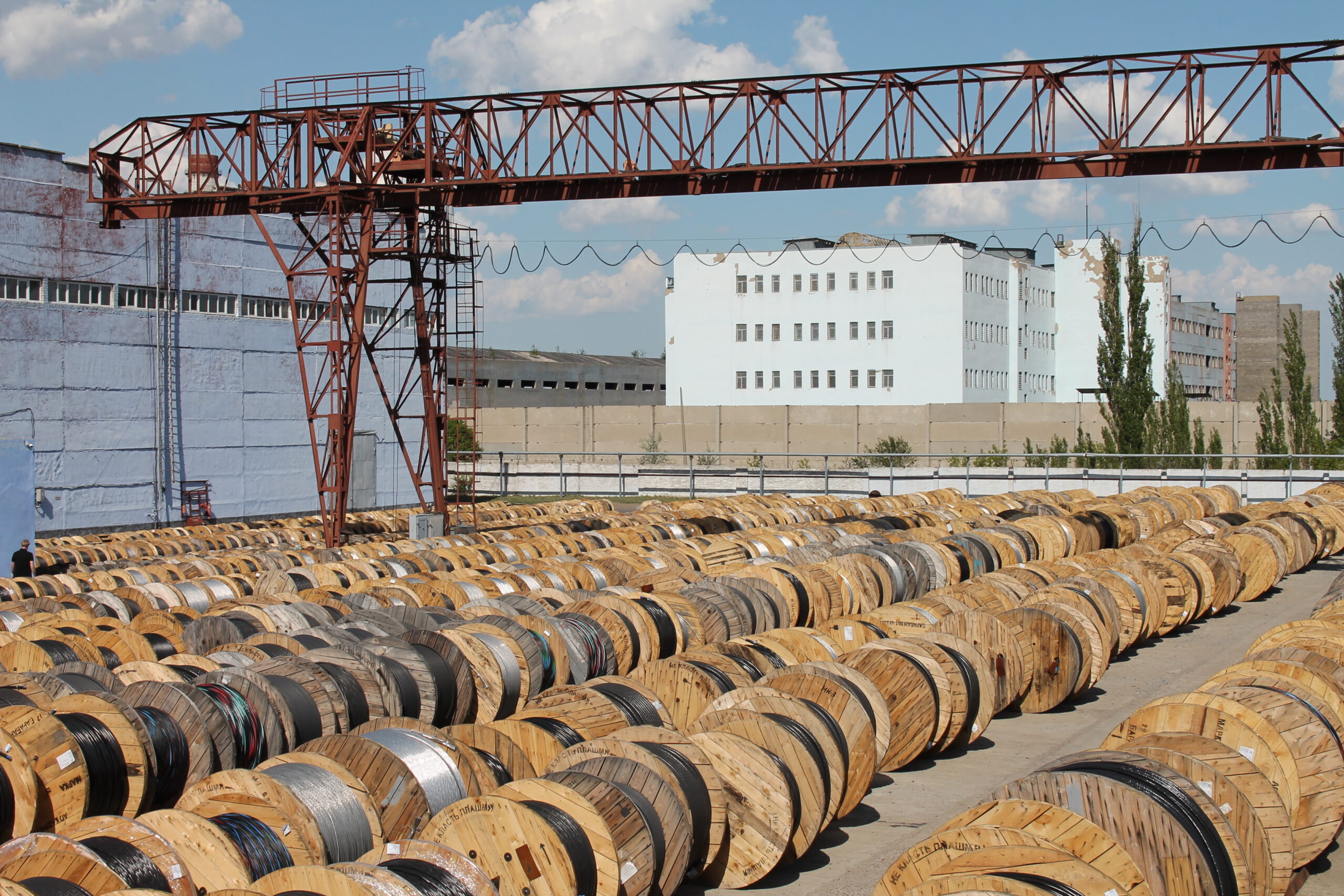
Optical cable is the foundation of modern high‑speed data, television and telephony networks. Signal transmission over quartz strands immune to electromagnetic interference has made it possible to increase the range and throughput of lines hundreds of times compared with copper conductors. In this article we will examine what components make up a fiber‑optic line, how single‑mode and multimode differ, what constructions exist according to installation conditions, how to organise reliable installation and perform measurements. Industrial production of optical fiber with various fiber counts and sheath types is presented in the optical cable production section.
1. History, Development and the Purpose of Optical Cable
The idea of transmitting light through transparent fibers emerged as early as the mid‑20th century, and the first industrial optical cable with an attenuation of less than 20 dB/km was produced in the 1970s. Today, a fiber‑optic line is capable of transmitting light pulses over distances from a few meters to thousands of kilometers without regeneration. Such communication underlies providers’ backbone networks, urban rings, structured cabling systems of enterprises, video surveillance systems, and data processing centers. A subscriber drop cable brings the signal to an apartment or office using FTTx technology. An optical cable for the internet, TV and IP‑telephony can serve hundreds of subscribers simultaneously. Hybrid types containing copper conductors for power supply – a so‑called composite or hybrid cable – are manufactured separately. All this makes fiber‑optic systems an indispensable element of the digital economy.
2. Construction and Key Elements
Any optical cable contains one or more optical modules with fibers, a central strength member, a hydrophobic filler or water‑blocking tapes, and an outer sheath. Let us examine the structure in more detail.
Core and cladding of the fiber. A glass fiber consists of a core with a diameter of 8–10 µm for single‑mode and 50 or 62.5 µm for multimode fiber. The core is surrounded by a quartz cladding with an outer diameter of 125 µm. The difference in refractive indices keeps the light inside the core by total internal reflection. Common sizes are 9/125 (single‑mode OS2), 50/125 (multimode OM2–OM4), 10/125 (for some special types with an extended window).
Buffer coatings and optical modules. The fiber is coated with a primary acrylate buffer to a diameter of 250 or 900 µm, which protects against microbending. Several fibers are combined into a tubular module made of polybutylene terephthalate, filled with hydrophobic gel. The modular construction makes it possible to compactly place from 2 to 144 fibers and more. One cable may contain from one to several tens of modules stranded around a central member.
Strength members. The central rod of fiberglass or steel bears the tensile loads. All‑dielectric versions, containing no metal, are preferred for suspension on power line poles and for eliminating ground loops. Additionally, aramid yarns can be introduced into the stranding, imparting flexibility and resistance to jerks. In self‑supporting cables, the strength members are arranged at the periphery, providing a withstood force of up to 7 kN and more.
Sheaths and protective coverings. An inner sheath of polyethylene or LSZH compound is applied over the core. For outdoor routes, armor of steel tape or wires is added, and over it – an outer sheath. Fire‑resistant cables for installation inside buildings are produced with the indices ng(A)‑HF, LSZH or FRHF. Armored constructions with a withstood force of up to 7 kN and more are intended for burial in the ground, and reinforced polyethylene sheaths for installation in cable ducts. For submarine crossings, multi‑barrier structures with copper or aluminum laminate are used.
3. Fiber Types and Standards (G.652, G.657, OM2–OM4)
Fibers are classified by the number of transmitted modes. Single‑mode fiber transmits one mode, provides low loss and a wide bandwidth at wavelengths of 1310 and 1550 nm. The basic standard is G.652.D, suitable for most backbones. G.657.A1 features increased bending resistance, which is important for subscriber distribution and compact closures. There are also G.655 fibers (NZDSF) for DWDM systems with non‑zero shifted dispersion. Multimode fiber transmits several modes, is cheaper in active equipment, but is limited to a distance of up to 550 m for 10 Gbit/s. Categories OM2 (50/125), OM3 and OM4 (laser‑optimized) are popular.
The difference between single‑mode and multimode fiber lies in the core diameter, bandwidth and segment length. Single‑mode is used on kilometer‑long backbones, multimode – in data centers and local networks. Externally, single‑mode cable is often marked with yellow, multimode – with orange or aquamarine; however, the decisive factor is the documentation and the markings on the sheath. The fiber colors in a module are standardized: blue, orange, green, brown, etc. according to IEC 60304.
| Fiber type | Core/cladding diameter, µm | Standard | Wavelength, nm | Typical attenuation, dB/km | Application |
| Single‑mode OS2 | 9/125 | G.652.D | 1310 / 1550 | 0.35 / 0.22 | Backbones, WDM |
| Single‑mode bend‑resistant | 9/125 | G.657.A1 | 1310 / 1550 | 0.5 / 0.3 | Subscriber networks, FTTx |
| Multimode OM2 | 50/125 | G.651.1 | 850 / 1300 | 2.5 / 0.8 | LAN, up to 1 Gbit/s |
| Multimode OM3/OM4 | 50/125 | TIA/EIA-492AAAD | 850 | 2.5 / 0.8 | Data centers, 10–40 Gbit/s |
| Single‑mode NZDSF | 9/125 | G.655 | 1550 | 0.22 | DWDM backbones |
4. Classification of Cables by Installation Conditions and Design
Optical cable for outdoor installation must withstand ultraviolet radiation, moisture, wind and ice loads. For overhead lines on poles and along posts, a self‑supporting aerial optical cable is produced, in which the strength member withstands tension up to 7–12 kN. A self‑supporting all‑dielectric variant with an LSZH sheath is not afraid of induced currents. For direct burial, an armored cable with steel tape or wire, resistant to crushing and rodents, is used. Models with a reinforced polyethylene sheath are laid in cable ducts and pipes. Underground armored cables have additional protection against moisture in the form of aluminum laminate or a copper tube.
For indoor installation, flexible cords with an LSZH sheath that does not propagate flame are used. They are often called patch cords; they have SC, LC, FC connectors at the ends. An indoor 4‑fiber cable is convenient for laying from the floor distribution cabinet to apartments. A flat drop cable with two fibers is a typical solution for subscriber lead‑in. For an enterprise distribution network, modular cables with a fiber count from 8 to 48 are used. For submarine crossings, special reinforced constructions with double armor and sealing by a copper tube have been developed.
5. Marking and Popular Types of Optical Cables
The designation of an optical cable contains information about the fiber type, number of modules, fiber count, sheath material and permissible tension. Let us consider several examples.
- OKSN 8 A-2,7 – optical cable self‑supporting, 8 single‑mode fibers, with a peripheral strength member, permissible tension 2.7 kN.
- OKMB 16 G.652D – trunk armored cable, 16 single‑mode fibers according to G.652D.
- DPO 2 G.657A – flat drop cable, 2 fibers, standard G.657.A1.
- OKB-8ng(A)‑HF – armored, 8 fibers, halogen‑free sheath, non‑flame propagating, for indoor installation.
Fiber counts of 4, 8, 16, 24, 48, 144 are also common. For backbones, 24‑fiber or 40‑fiber is ordered. 2‑fiber is used in subscriber drops, 4 fibers – for connecting buildings, 8 fibers – for distribution points. The marking LSZH, HF, FRHF indicates the fire safety of the sheath. Models for burial are designated by the letter “B” (armor), e.g. OKB-16. For overhead lines, types OKSN, OKMS, DPO are used. More details about the production of various types can be found on the optical cable production page.
6. Table of Popular Versions by Fiber Count and Application
| Fiber count | Typical type | Design features | Application |
| 1 | OV 9/125 (simplex) | Single‑mode fiber in 0.9 mm buffer | Patch cords, pigtails |
| 2 | Drop cable 2 fibers G.657 | Flat, with a strength member | FTTH subscriber lead‑in |
| 4 | Indoor 4 fibers LSZH | Module with four fibers | Floor distribution |
| 8 | OKSN 8 G.652D | Self‑supporting, all‑dielectric | Settlement distribution network |
| 16 | OKB-16 | Armored with steel tape | Direct burial |
| 24 | OKMB 24 G.652D | Multi‑module, with armor | Urban ring |
| 48 | OKL 48 | Ribbon modules | Provider backbone |
| 144 | OKL 144 | High capacity | Long‑distance lines |
7. Comparison with Copper Cables and Hybrid Solutions
Optical cable fundamentally differs from copper in the method of transmission. UTP twisted pair transmits electrical signals, is susceptible to interference and is limited to 100 meters. Coaxial cable preserves the signal over a greater distance, but loses to optical fiber in bandwidth. Fiber‑optic cable does not radiate outward, is not afraid of thunderstorms and provides speeds up to 400 Gbit/s over a single fiber with DWDM multiplexing. A network optical cable for a router or terminal is connected via SFP modules, and for a TV – via a media converter or directly to a receiver with an optical input. Unlike copper, optical cable does not transmit power, so a hybrid cable, combining copper and optical fiber in one sheath, is sometimes produced. Such a cable contains single‑mode fibers and copper conductors for powering remote nodes, for example, video surveillance cameras or 5G base stations.
8. Installation of Optical Cable: From the Drum to the Closure
Installation of optical cable requires carefulness and special qualifications. The minimum bending radius during installation is 20 cable diameters, during operation – 10 diameters. Exceeding these values causes attenuation and can break the fiber. Steel pull tape and a pulling stocking are used for pulling into cable ducts or pipes. Suspension clamps and tension fixings secure self‑supporting lines on poles. When entering a building, a service loop of 5–10 m is left, placed in a closure or cabinet.
Preparation is performed with a special tool – a stripper, removing the sheath layer by layer. First the outer sheath is removed, then the armor, if present, and the inner sheath. The modules are cleaned of hydrophobic compound, and the fibers are freed from the buffer. Fiber splicing is performed by an automatic fusion splicer, which aligns the fibers by the core and performs thermal splicing. The splice point is protected by a heat‑shrinkable splice protector and placed in the splice tray of the closure. For operational connection without splicing, mechanical connectors are used. A closure for optical cable seals the joint site and provides a reserve of fibers for re‑installation. An adapter for optical cable makes it possible to mate connectors of different types, for example SC and LC. In distribution cabinets and cross‑connects, patch panels with ports for optical connectors are installed.
9. Passive Components: Connectors, Adapters, Outlets
For terminating optical fibers, connectors of type SC, LC, FC, ST are used. The LC connector is distinguished by compactness, SC – by reliable fixation. The contact polish can be UPC of blue color, APC – green with an angled end face to reduce back reflections. A pigtail is a length of fiber with a connector at one end, intended for splicing to a trunk fiber in a closure or cross‑connect. A patch cord is a connecting cord with connectors at both ends; its length varies from 0.5 to 100 m. An optical outlet in an apartment or office covers the wall entry and protects the fiber from breakage. Adapters, or inline outlets, serve for mating two connectors of the same or different type.
10. Parameters, Measurements and Quality Control
Before handing over the line, incoming inspection is carried out on the drum with an OTDR. The device measures length, attenuation, reflection coefficients and reveals inhomogeneities. The transmitter and receiver power is monitored with an optical power meter and a stabilized light source. Reference values for single‑mode fiber according to G.652D: attenuation at 1310 nm – not more than 0.35 dB/km, at 1550 nm – 0.22 dB/km. For multimode at 850 nm, up to 3.0 dB/km is allowed. Permissible losses in a fusion splice – not more than 0.1 dB, in a connector – up to 0.5 dB. The total attenuation of the line together with the connectors must not exceed the budget calculated according to the active equipment passport. The measurement results are documented in a report, and a passport with an installation diagram and a map of the OTDR traces is drawn up for the line.
11. Regulatory Framework and Certificates
The production and operation of optical cables in Russia are regulated by GOST R 52266‑2004, GOST R IEC 60793‑1‑2018, as well as the technical specifications of the manufacturing enterprises. For indoor installation, fire safety certificates are mandatory: ng(A)‑LS, ng(A)‑HF, FRLS. Each batch is accompanied by a passport indicating the fiber type, attenuation coefficient, and geometric parameters. During acceptance testing, the integrity of the fibers, the attenuation in factory lengths and on installed transitions are checked.
12. Conclusion
Optical cable is a complex technical device combining the fragility of glass and high mechanical strength achieved by a multilayer construction. Understanding the differences between single‑mode and multimode, the G.652 and G.657 standards, armored and self‑supporting designs, as well as the rules of preparation and splicing, makes it possible to build networks that serve for decades without degradation of parameters. To order a cable of the required capacity and construction, please refer to the optical cable production section.