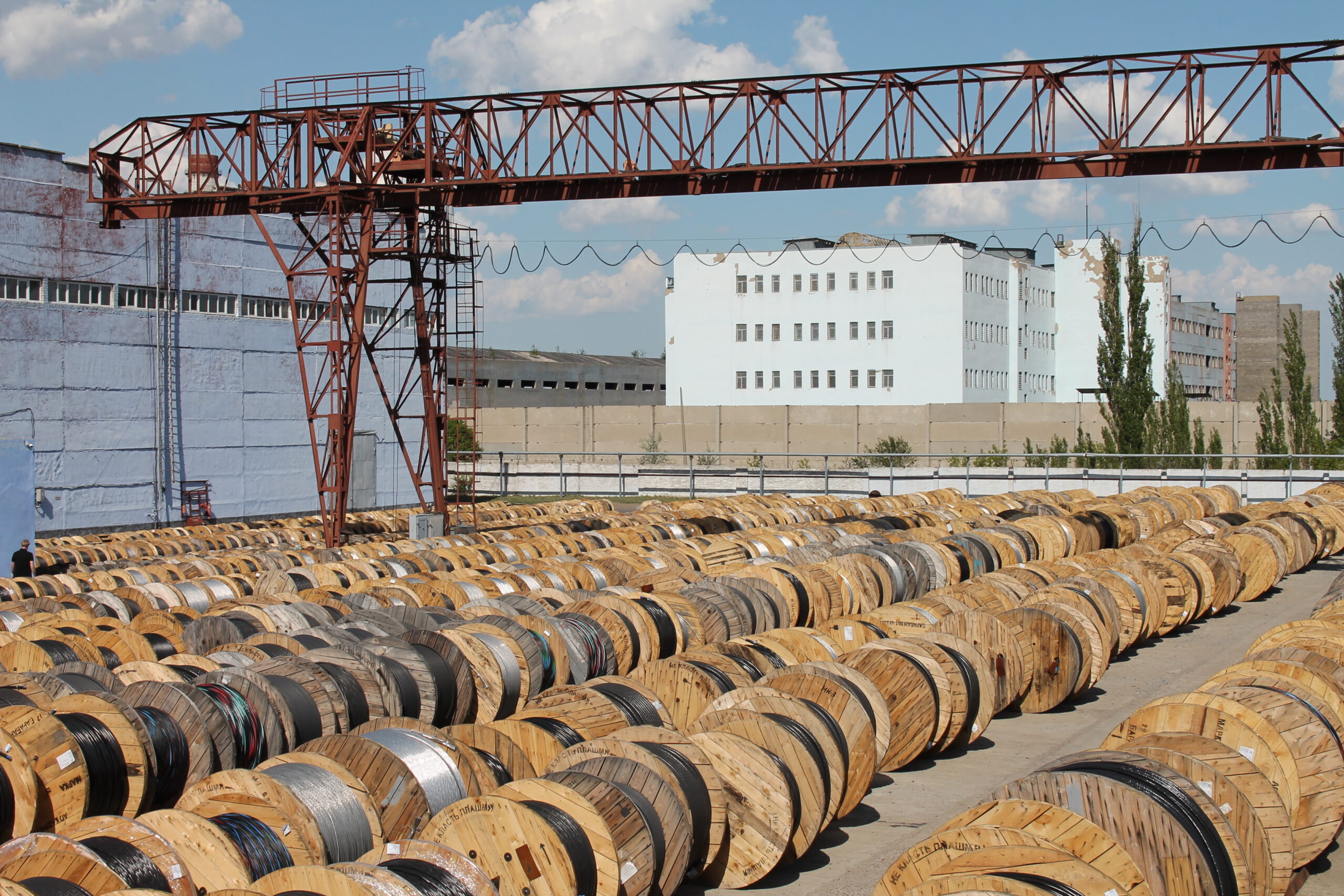
MKEShV Cable: Versatile Mounting Wire for Complex Tasks
MKEShV cable is a versatile mounting wire with copper conductors, designed for fixed installation inside electrical apparatus, instruments, machine tools, distribution boards, and control cabinets. Its primary task is to provide flexible, reliable, and durable electrical connections between components in conditions of limited space, vibration, and elevated temperatures. This wire acts as the “nervous system” of industrial equipment, automation means, and special machinery, where compactness and resistance to mechanical influences are crucial.
1. Main Tasks and Application Areas
MKEShV cable is used for creating internal electrical circuits in equipment requiring flexible, heat-resistant, and vibration-resistant connections. Main application areas:
- Industrial Equipment and Machine Tools: Internal wiring in CNC machines, presses, machining centers, robotic complexes.
- Electrical Enclosures and Control Cabinets (APCS): Installation of control circuits, signaling, power supply for sensors and relays inside PLC cabinets.
- Marine and River Fleet Vessels: Electrical installation of ship equipment due to resistance to vibration, high humidity, and qualification according to River and Maritime Register standards.
- Rolling Stock (diesel locomotives, electric locomotives, carriages): Internal carriage and locomotive wiring for control, lighting, and communication systems.
- Aerospace Engineering (in certified versions): Installation of onboard electrical equipment.
- Medical and Laboratory Equipment: Connections inside complex devices where flexibility and material purity are important.
- Connections in High-Temperature Conditions: Near heating elements, in ovens (within the permissible temperature range).
2. Construction, Materials, and Marking Decoding
The construction of MKEShV cable is optimized for flexibility, compactness, and operation in challenging conditions. Its marking reveals key features:
| Letter in Marking | Meaning of Designation | Structural Element and Purpose |
| M | Montazhny (Mounting) | Indicates the main purpose of the wire — for mounting (installation work) inside equipment. |
| K | Kabel (Cable) or Kontrolny (Control) | In this context, emphasizes that it is a multi-core wire for control and signaling circuits. |
| E | Ekran (Shield/Screen) | Presence of a shielding braid made of tinned copper wires. Critically important for protecting low-current analog and digital signals (e.g., from sensors) from electromagnetic interference inside the cabinet. |
| Sh | Shelkovaya opletka (Silk Braid) | Outer braid made of lavsan or natural silk threads. Performs several functions: protects against abrasion, binds the shield, serves as a base for applying varnish, and provides flexibility and elasticity. |
| V | Insulation from Polyvinyl Chloride (PVC) compound | Denotes the insulation material of the current-carrying conductors. PVC compound provides good dielectric properties, flexibility, and resistance to aggressive environments. |
Thus, MKEShV cable is a mounting shielded cable in a silk braid with PVC insulation. There is also a modification MKEKShV, where the additional letter “K” may denote silicone (kremniyorganicheskaya) insulation of the cores, which increases heat resistance.
3. Key Technical Characteristics and Advantages
The combination of design features determines the unique properties and advantages of MKEShV over other mounting wires.
| Characteristic | Value / Description | Practical Benefit and Advantage |
| Increased Flexibility | Conductor flexibility class — not lower than 5 (multi-wire, fine-wire). Presence of silk braid. | Allows installation in confined spaces, bending around obstacles, laying in bundles with a small bending radius (down to 2-3 outer diameters). Facilitates maintenance and replacement. |
| Shielding | Tinned copper braid with coverage density of at least 70-80%. | Effectively suppresses electromagnetic interference, indispensable for laying near power circuits, frequency converters, and data transmission lines. Ensures signal integrity in APCS systems. |
| Heat Resistance | Long-term permissible operating temperature: from -60°C to +70°C (for PVC insulation). Modifications with silicone insulation (MKEKShV) — up to +180°C. | Allows operation in unheated rooms, under temperature fluctuations, near heat sources. Expands the scope of application. |
| Vibration Resistance and Wear Resistance | Silk (lavsan) braid protects against abrasion from sharp edges and vibration. | Guarantees a long service life in mobile installations, transport (ships, locomotives), and under constant vibration from machinery. |
| Resistance to Aggressive Environments | Resistance to mold fungi, many oils, weak acids and alkalis (due to PVC). | Applicable in chemical, food industry workshops, and in high humidity conditions (shipping). |
| Compactness | Small outer diameter due to thin insulation and the absence of a thick outer sheath. | Allows placing more wires in one bundle or cable duct, which is critical for complex equipment. |
4. Criteria for Selecting MKEShV Cable
When choosing a specific version of MKEShV cable for a project, several key parameters must be considered.
| Selection Criterion | What to Consider | Selection Recommendations |
| Number and Cross-section of Cores | From 2 to 60 or more cores. Cross-section: from 0.35 mm² to 6 mm² (most common: 0.5, 0.75, 1.0, 1.5 mm²). | Selected according to the equipment’s electrical diagram. For control and signaling circuits, 0.5-0.75 mm² is usually sufficient. For powering low-power devices — 1.0-1.5 mm². |
| Presence and Type of Shield | Braid (denoted by “E”). Options with foil shield or without shield (MKShV) exist. | MKEShV cable (with braid shield) is mandatory for circuits transmitting analog signals (4-20 mA), sensors, communication (RS-485) inside the cabinet. For DC or AC power circuits inside the panel, an unshielded analogue can be used. |
| Insulation Heat Resistance | PVC compound (up to +70°C) or silicone rubber (up to +180°C — grade MKEKShV). | For standard control cabinets, PVC version is sufficient. For locations with high heat dissipation (ovens, boilers, near powerful resistors), choose the heat-resistant modification MKEKShV. |
| Core Insulation Color | Solid color (white, red) or with color coding (for ease of installation). | For complex installations with a large number of cores, cable with color coding according to GOST or international standards (brown, blue, green/yellow, etc.) is preferable. |
| Certification for Industries | Presence of approvals: Russian River Register (RRR) or Maritime Register, for railway transport, aviation. | For marine or railway applications, it is necessary to specifically request cable that has the relevant certificate and marking. |
| Quality of Braid and Shield | Uniformity and density of braid application. | Visually check that the braids are not sparse and do not slip. This affects mechanical protection and shielding effectiveness. |
5. Features of MKEShV Cable Installation and Stripping
- Terminating the Shield: The shield in the form of a copper braid must be properly grounded to perform its function. Usually, the braid is gathered into a pigtail, crimped with a ferrule or a special sleeve, and connected to a grounding terminal on the DIN rail or cabinet body.
- Abrasion Protection: Despite the durable braid, when laying through metal partitions or panels, it is necessary to use feedthrough bushings or cable glands to prevent chafing against sharp edges.
- Forming Bundles: Thanks to flexibility and the silk braid, MKEShV wires are excellent for forming bundles. Use cable ties, insulating tubes, or lacing cord for fixation. Do not overtighten the ties to avoid deforming the insulation.
- Soldering and Crimping: Tinned copper cores are well-suited for soldering and crimping. When soldering, use flux that does not damage the PVC insulation. For crimping, use ferrules of the appropriate cross-section (e.g., NSHVI, NVI).
- Considering the Minimum Bending Radius: Although the cable is flexible, avoid sharp bends. The recommended bending radius is at least 2-3 times the outer diameter of the cable for stationary installation.
6. Conclusion
MKEShV cable is a professional solution for internal mounting where requirements for flexibility, noise immunity, compactness, and resistance to harsh conditions are paramount. Choosing it for equipping industrial control cabinets, machine tools, marine and transport equipment is an investment in the reliability, uninterrupted operation, and ease of maintenance of the entire system. Using high-quality MKEShV cable that meets specifications is the key to durable and stable electrical connections.
Purchasing mounting cables from a trusted manufacturer, such as JSC “Kazenergokabel”, guarantees exact compliance with the stated characteristics, whether it’s the standard version or the heat-resistant MKEKShV modification. You can explore the full range of cable and wire products in our catalog.