Short Answer: What to Check First
Incoming inspection of a cable upon receipt of a batch includes three mandatory stages: checking the accompanying documentation and marking, visual inspection of the drums and cable, and electrical measurements. Electrical measurements include determining the DC resistance of the current-carrying conductors, measuring insulation resistance and, if necessary, testing the insulation with increased voltage. Without accompanying documentation certifying quality and completeness, the product is not subject to acceptance.
The scope of tests during incoming inspection is smaller than during factory acceptance tests, but it is sufficient to identify non-conformities before installation. The standard sample for incoming inspection of cables for compliance with requirements is 3% of drums or coils from the batch, unless otherwise established by the contract or technical specifications for specific types. A batch is cables of the same type presented for acceptance at the same time; the minimum batch size is three drums or coils.
What Is Checked and Why
Each type of check has a physical meaning and is responsible for a specific risk.
Accompanying documentation. The tag on the drum, the passport or quality certificate, and the certificate of conformity to the requirements of the technical regulation are checked. The tag indicates the cable name, type, length, manufacturer, batch number and date of manufacture. The goal is to ensure that the ordered type, length and cross-section have been delivered, and that the manufacturer confirms compliance of the product with regulatory requirements.
Marking on the sheath. The presence and legibility of the inscription on the outer sheath are checked. The marking must contain the cable type or designation, the name or code of the manufacturer, and the year of manufacture. The absence of marking on the sheath, including the absence of the manufacturer’s identification code, is a typical sign of counterfeit products.
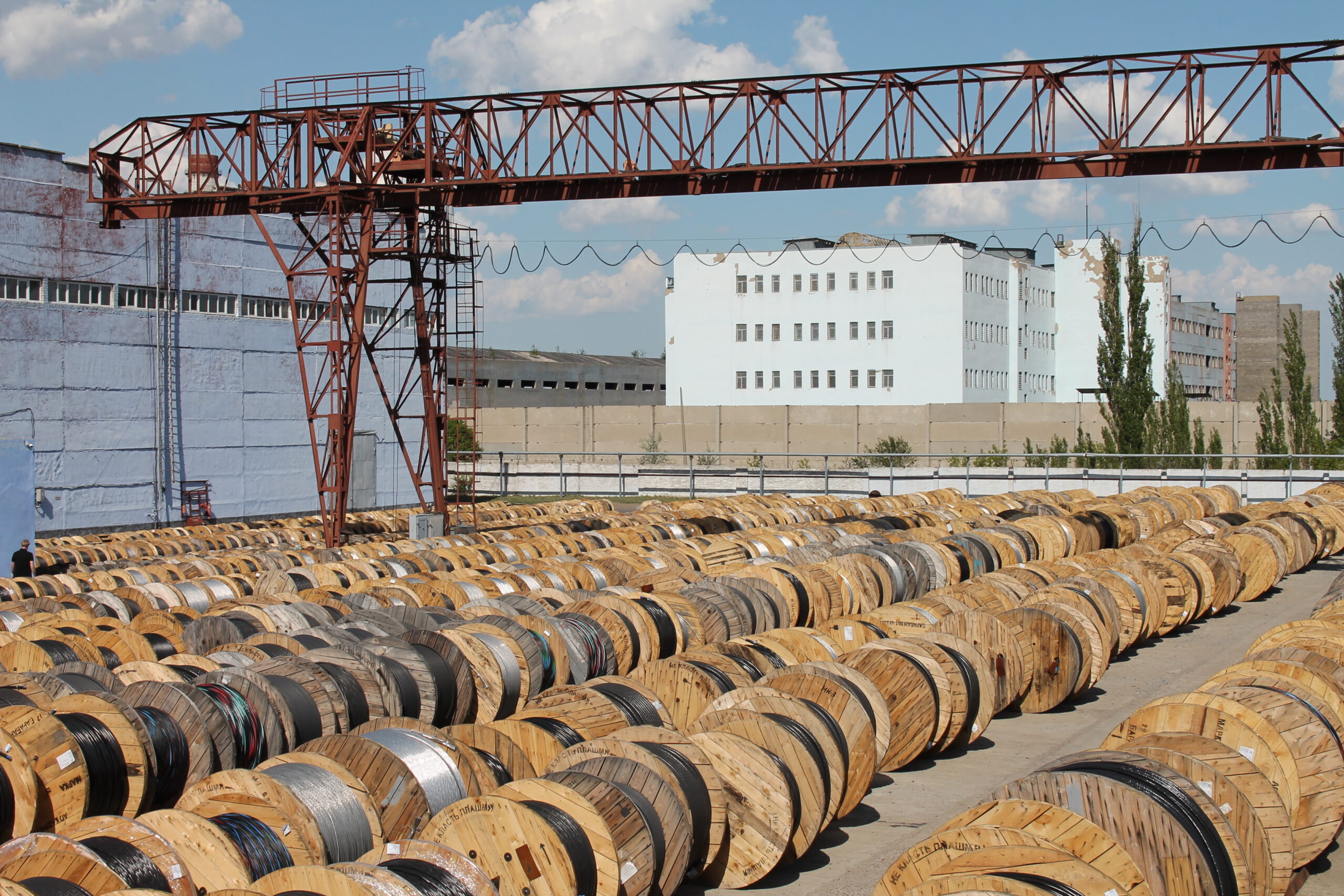
Visual inspection. The integrity of the drum sheathing, packaging, and the absence of mechanical damage to the outer sheath are checked: punctures, deep scratches, cuts, through holes. Both ends of the cable must be hermetically sealed with cable terminations. The goal is to exclude damage received during transportation and loading.
DC resistance of current-carrying conductors. Physical meaning: if the actual conductor cross-section is less than declared, the resistance will be higher than standardised. The measurement reveals an understated cross-section — the most common non-conformity of low-quality cable. The determination method is according to GOST 7229-76, the instrument is a single, double or single-double DC bridge.
Insulation resistance. Physical meaning: insulation separates the conductors and protects against current leakage. Measurement with a megohmmeter reveals insulation defects, moisture, contamination. The measurement is carried out before and after testing the cable with increased voltage, if such a test is provided.
Insulation test with increased voltage. Physical meaning: checking the dielectric strength of the insulation at a voltage above the working voltage. The insulation is considered to have passed the test if no breakdown occurred and there were no sliding discharges. For power cables up to 1 kV, a one-minute insulation test may be replaced by measuring insulation resistance with a 2500 V megohmmeter.
When the Inspection Is Carried Out
Incoming inspection is part of the quality control system. It should not be confused with other types of tests.
Production. Factory acceptance tests are carried out by the manufacturer. Cables are presented for acceptance in batches. The composition of tests includes checking the design and design dimensions, determining the electrical resistance of the current-carrying conductors, checking the electrical resistance of the insulation, voltage testing, and checking the marking of the conductors. Products that have not passed factory tests do not arrive for incoming inspection.
Acceptance at the site. Incoming inspection is carried out by the consumer upon receipt of the batch. This is the first stage at which non-conformities are identified before installation. The results are recorded in the incoming inspection log. If damage to the packaging or non-conformities are detected, a report is drawn up, and the product is held until a commission decision with the supplier.
After installation. Post-installation tests include checking the integrity and phasing of the conductors, measuring insulation resistance, and testing with increased rectified voltage for cables above 1 kV. These tests are carried out before commissioning. Incoming inspection does not replace them.
Operation and troubleshooting. Diagnostics of damage is a separate area. Other methods and instruments are used to locate the damage: reflectometers, acoustic and induction methods. Incoming inspection has nothing to do with these tasks.
How It Is Carried Out
Checking Documents and Marking
Before opening the drum, the tag data is compared with the contract and shipping documents: type, length, cross-section, number of conductors, manufacturer, batch number. The presence of a certificate of conformity to the requirements of the technical regulation is checked. If the product is supplied with a voluntary certification certificate and the mandatory certificate is absent, this is a sign of non-conformity. Opening the drum sheathing is carried out with a representative of the supplier. After removing the sheathing, the marking on the cable sheath is checked: type, manufacturer, year of manufacture.
Visual Inspection
The outer sheath is inspected along the entire accessible length. Attention is paid to mechanical damage, traces of overheating, and foreign inclusions. The tightness of the cable end sealing is checked. When inspecting the cable on the drum, it is verified that both ends are hermetically sealed. An inspection report is drawn up.
Measuring Conductor Resistance
The method for determining the DC electrical resistance of current-carrying conductors is according to GOST 7229-76. The measurement is carried out on construction lengths. The instrument is a DC bridge. Before measurement, the cable must be kept under normal climatic conditions. The result is brought to +20 °C. The measured resistance is compared with the standardised value for the given cross-section and conductor material.
Measuring Insulation Resistance
It is performed with a megohmmeter. For power cables up to 1 kV, the measurement is carried out with a 2500 V megohmmeter. For control cables, a 1000 V megohmmeter is permitted. The measurement is carried out between each conductor and the remaining conductors connected to the sheath, as well as between conductors. The reading is taken after the instrument needle stabilises.
Increased Voltage Test
For power cables up to 1 kV, a one-minute insulation test may be replaced by measuring insulation resistance with a 2500 V megohmmeter. If an increased voltage test is carried out, it is performed with AC voltage at a frequency of 50 Hz. The peak value of the test voltage depends on the insulation thickness and is determined according to GOST 23286. For 0.66 kV cables, the test voltage is 3 kV, for 1 kV — 3.5 kV, for 3 kV — 9.5 kV (AC test at 50 Hz for 10 minutes or DC voltage 2.4 times the AC voltage).
How to Evaluate the Result
Normal results and possible deviations with probable causes are summarised in the table.
| Parameter | Normal result | Deviation | Probable cause |
| Accompanying documents | Tag, passport, certificate of conformity present, data match | Missing documents, data mismatch | Supplier error, counterfeit, mixed-up delivery |
| Marking on the sheath | Legible marking with type, manufacturer, year | No marking, illegible marking | Counterfeit, violation of marking technology |
| Visual inspection | Sheath without damage, ends sealed | Punctures, cuts, scratches, unsealed ends | Damage during transportation, packaging violation |
| DC resistance of conductors | Corresponds to the norm for the given cross-section and material | Exceeds the standardised value | Understated actual conductor cross-section |
| Insulation resistance (cables up to 1 kV) | Not less than 0.5 MΩ | Less than 0.5 MΩ | Insulation defect, moisture, contamination |
| Increased voltage test | No breakdown, no sliding discharges | Breakdown, sliding discharges, increasing leakage current | Insulation defect, local weakening |
Sources: PUE RK, section 29; GOST 31996-2012, clause 7.3; GOST 7229-76; GOST 3345-76. For control cables, insulation resistance must not be lower than 1 MΩ. For power cables above 1 kV, insulation resistance is not standardised.
What Can Distort the Measurement
Temperature. The DC resistance of conductors depends on temperature. The measurement result is brought to +20 °C. If the cable temperature differs from the standardised one, a temperature coefficient is introduced. Measuring insulation resistance at negative temperatures does not reveal moisture: water in a frozen state is a dielectric. Tests are carried out at positive ambient temperature.
Humidity. During high-voltage tests, condensation on the spark gaps and insulators of the test installation can lead to breakdown. Before testing, the cable funnels are wiped from dust, dirt and moisture.
Line length. The conductor resistance is proportional to length. When measuring on short sections, the error is higher. The measurement is carried out on construction lengths.
Condition of end terminations. Poor contact at the connection point of the measuring instrument gives an overestimated resistance. The conductor ends must be stripped.
Equipment error. The DC bridge must have an instrumental error not exceeding that specified in GOST 7229-76. The megohmmeter must be calibrated.
Inductive component. When measuring conductor resistance to alternating current on long cables, an inductive component appears. Therefore, conductor resistance is measured to direct current.
What to Do in Case of Deviation
When a deviation is detected, the next diagnostic step depends on the type of non-conformity.
Documents and marking. If documents are missing or data do not match, the product is not subject to acceptance. It is stored separately from accepted products, marked as defective and held until a commission decision with the supplier. A certificate of conformity is requested and its presence in the register of accredited bodies is checked.
Visual damage. A report is drawn up recording the damage. Opening the drum sheathing is carried out with a representative of the supplier. The product is held until a joint decision.
Conductor resistance above normal. The probable cause is an understated cross-section. A repeat measurement is carried out on another section of the cable, the temperature and contact quality are checked. If the excess is confirmed, the cable does not correspond to the declared cross-section. The decision on further use is made by the commission. For critical lines, such a cable is not used.
Insulation resistance below normal. The condition of the end terminations is checked: contamination, moisture. The ends are wiped, and the measurement is repeated. If the resistance remains low, the insulation is defective. The cable is not subject to use without restorative repair or replacement.
Breakdown during increased voltage test. The cable is considered to have failed the test. The breakdown location is localised, and a decision is made on repair or replacement of the section.
Typical Mistakes
Ignoring accompanying documentation. The cable is accepted based on its presence, without comparing the type, length and cross-section with the contract. As a result, products with an understated cross-section or a different type arrive at the site.
Measuring insulation resistance at negative temperature. Frozen water in the insulation is not detected, the cable is recognised as suitable, and after thawing the resistance falls below normal.
Measuring conductor resistance without bringing it to +20 °C. The result is compared with the norm without temperature correction. At high temperature, the resistance is overestimated; at low temperature, it is underestimated. The evaluation is incorrect.
Checking only one conductor from a bundle. The resistance of conductors may differ. All conductors are measured, not just one selectively. Similarly, insulation resistance is measured between all pairs of conductors and between each conductor and the sheath.
Using an uncalibrated megohmmeter. The instrument error is not taken into account, and the result is invalid. The instrument must be calibrated, and its accuracy class must correspond to the requirements of the method.
FAQ
What is the sample size for incoming cable inspection?
For control cables, incoming inspection for compliance with the standard requirements is carried out on 3% of drums or coils from the batch. A batch is cables of the same type presented for acceptance at the same time; the minimum batch size is three drums or coils. For power cables, the sample size is established by the contract or technical specifications for specific types.
Can the increased voltage test be replaced by measuring insulation resistance?
For power cables up to 1 kV, a one-minute insulation test may be replaced by measuring insulation resistance with a 2500 V megohmmeter. For cables above 1 kV, an increased rectified voltage test is mandatory. The decision is made by the person responsible for testing, taking into account the requirements of PUE RK.
What insulation resistance is considered normal for a power cable up to 1 kV?
Not less than 0.5 MΩ. For control cables — not less than 1 MΩ. The measurement is carried out with a 2500 V megohmmeter. For power cables above 1 kV, insulation resistance is not standardised.
What to do if the conductor resistance exceeds the norm?
The probable cause is an understated actual conductor cross-section. A repeat measurement is carried out on another section, the temperature and contact quality are checked. If the excess is confirmed, the cable does not correspond to the declared cross-section. For critical lines, such a cable is not used. The decision on further use is made by the incoming inspection commission.
Is it necessary to check conductor marking during incoming inspection?
Yes. Checking the marking of conductors is part of the acceptance tests. The marking must comply with GOST 31996-2012, clause 5.2.1.10. The check is performed by visual inspection and testing the durability of the marking. If the marking does not meet the requirements, the cable is considered to have failed the test.
Sources
- Electrical Installation Code of the Republic of Kazakhstan 2015, as amended by the order of the Minister of Energy of the Republic of Kazakhstan dated 31.10.2022 No. 340 — section 29 “Power cable lines” — IPS “Adilet”, adilet.zan.kz — norms of acceptance tests, insulation resistance, test voltages.
- GOST 31996-2012 “Power cables with plastic insulation for rated voltages of 0.66; 1 and 3 kV” — in force — clause 7.3 “Acceptance tests”, clause 5.2.1.10 — composition of tests, conductor marking, acceptance rules.
- GOST 7229-76 “Cables, wires and cords. Method for determining the electrical resistance of current-carrying conductors and conductors” — in force — official portal of Rosstandart, protect.gost.ru — method for measuring DC resistance of conductors.
- GOST 3345-76 “Cables, wires and cords. Method for determining electrical insulation resistance” — in force — method for measuring insulation resistance.
- GOST 23286-78 “Cables, wires and cords. Norms of insulation thickness, sheaths and voltage tests” — in force — norms of test voltages depending on insulation thickness.
- GOST 15.309 “System for development and launching of products into production. Tests and acceptance of manufactured products” — in force — rules for cable acceptance.
- GOST 18690-2012 “Cables, wires, cords and cable accessories. Marking, packaging, transportation and storage” — in force — requirements for marking and packaging.
- GOST 24297-87 “Incoming inspection of products. General provisions” — in force — general provisions of incoming inspection.
- TR CU 004/2011 “On the safety of low-voltage equipment” — in force — official portal of the EAEU, docs.eaeunion.org — mandatory certification of cables for voltages from 50 to 1000 V.